At a Glance
A wedge is a simple machine shaped like a triangle. It has a sharp, thin edge and a wide back. When you push the back, the sloped sides push outward. That push can split, cut or hold things in place.
- What it is
- A thin edge on a thick back
- What it does
- Splits, cuts, lifts or holds things
- Shape
- Like a triangle, or two ramps back to back
- Easy examples
- Knife, axe, doorstop, zipper, nail tip
- The trade
- Easier push, but it must go in farther
On this page
What Is a Wedge?
A wedge is one of the six simple machines. It is a hard object with one thin end and one thick end. Look at it from the side, and it looks like a triangle.
The thin end is called the edge or tip. The flat thick end is called the back. You push on the back. The edge goes into the thing you want to split or hold.
A wedge does not need wheels or a motor. Your own push makes it work. A wedge often moves while it does its job. That makes it different from a ramp, which stays still.
How Does a Wedge Work?
Picture two ramps glued back to back. That is a wedge! Each sloped side is a little ramp.
Push the back forward. Then the sloped sides press out to the left and right. So a push going forward turns into pushes going sideways. Those sideways pushes shove the wood or food apart.
- You push or hit the back of the wedge.
- The thin edge slips into a tiny crack or gap.
- The sloped sides press out on both sides.
- The gap gets wider and wider.
- The object splits, or the wedge gets stuck tight.
A push or pull is called a force. A wedge changes the direction of your force.
Why Do Sharp Wedges Work Better?
Some wedges are long and skinny. Others are short and fat. A long, skinny wedge needs a smaller push. But you must drive it in farther to open the gap.
A short, fat wedge opens the gap quickly. But you need a much bigger push. This trade happens in every simple machine. You can use less force, but you pay with more distance.
That is why people keep knives sharp. A sharp edge is very thin. It slides into food with a small push. A dull knife has a wider edge, so you must press much harder.
Rubbing also matters. Smooth sides slide in more easily than rough ones. Rubbing is called friction, and it helps a doorstop stay put.
Where Can You Find Wedges?
Wedges are all around you. Some cut, some split, and some hold things still.
- Knife and scissors: each blade is a thin wedge that cuts food or paper.
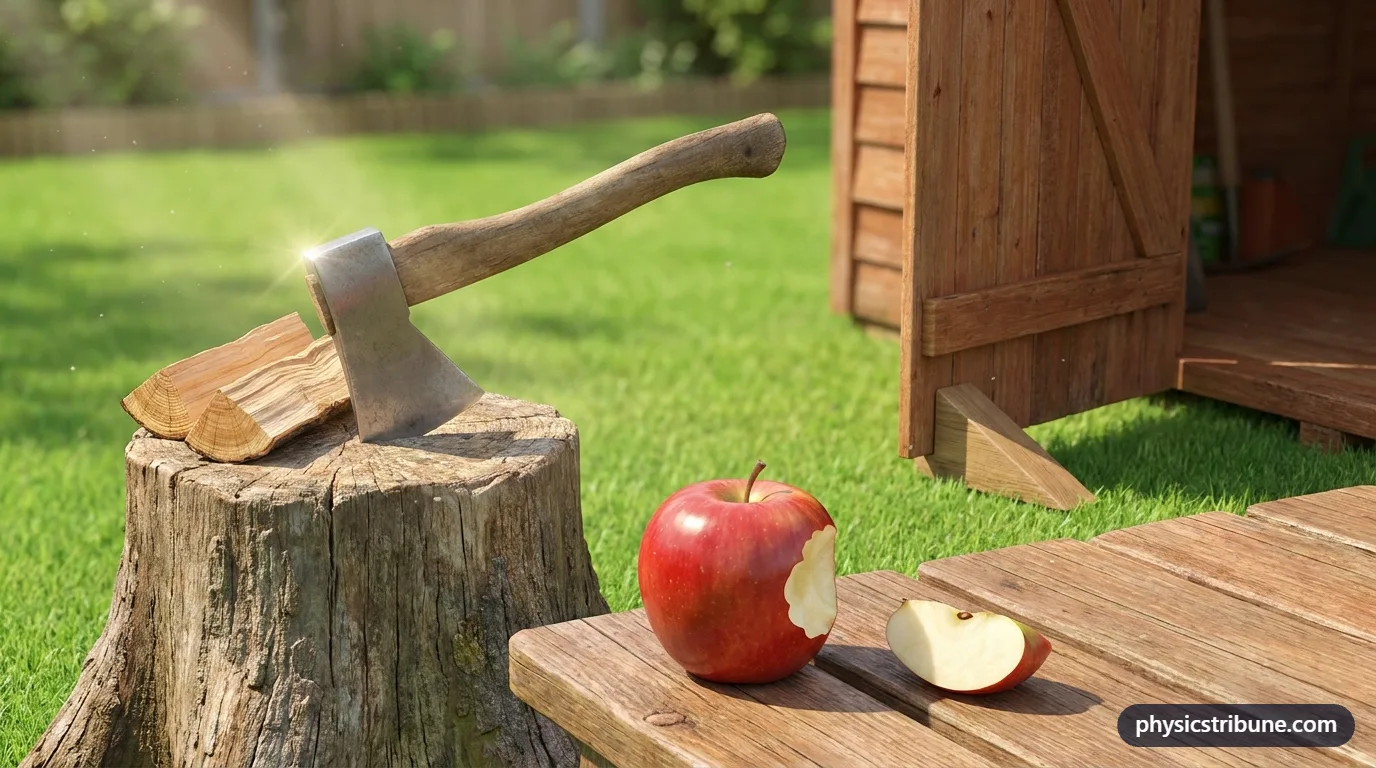
- Axe: it splits logs along the grain of the wood.
- Doorstop: it jams under a door and holds it open.
- Zipper: small wedges in the slider push the teeth together or apart.
- Nail and pin: the pointy tip is a tiny wedge. It pushes wood or cloth aside.
- Shovel and plow: the front edge slices into soil.
The table shows what each wedge does.
| Wedge | What it works on | Its job |
|---|---|---|
| Knife | Food | Cuts it into pieces |
| Axe | Logs | Splits the wood apart |
| Doorstop | A door | Holds it still |
| Zipper slider | Zipper teeth | Joins or opens them |
| Nail tip | Wood | Pushes the wood aside |
| Front teeth | Apples and carrots | Bite off a piece |
| Boat front | Water | Pushes the water aside |
| Source: Our own summary of common wedges · Retrieved October 2026 | ||
Are There Wedges in Nature and in Your Body?
Yes! Your front teeth are wedges. They are thin at the biting edge and thicker near your gums. They help you bite into an apple.
Animals have wedges too. A beaver uses sharp front teeth to chew through trees. A woodpecker uses its pointed beak to chip bark. The front of a fast fish or a bird's beak is wedge-shaped. That shape helps it slip through water or air.
Even ships use this idea. The front of a boat is narrow and pointy. It pushes water aside as the boat moves forward.
Try It at Home: Which Wedge Cuts Best?
You need a block of soft modeling clay and two plastic picnic knives. Ask an adult to help. Do not use sharp metal knives.
- Roll the clay into a thick, flat block.
- Press the thin edge of one knife into the clay. Notice how hard you push.
- Now turn the knife sideways. Press with the flat, wide side instead.
- Try a thick wooden craft stick too.
- Rank which edge was the easiest to push in.
The thinnest edge should slide in most easily. The wide side needs a much bigger push. You just tested sharp and dull wedges!

What Are Some Fun Facts About Wedges?
- Stone hand axes are among the oldest tools people ever made.
- Long ago, workers split big stones by tapping wedges into a row of holes.
- A zipper uses three tiny wedges inside the slider.
- An arrowhead is a pointed wedge.
- A ramp stays still, but a wedge usually moves while it works.
Common Misconceptions
Myth: A wedge has to be big and heavy to work.
Physics: A wedge can be tiny. The tip of a pin and the slider of a zipper are small wedges.
Myth: A wedge gives you extra energy for free.
Physics: A wedge lets you push with less force. But you must push it a longer distance.
Key Facts
- A wedge is a simple machine with a thin edge and a thick back.
- A wedge is like two ramps placed back to back.
- It turns a forward push into sideways pushes.
- A thinner, sharper wedge needs a smaller push.
- Knives, axes, doorstops and your front teeth are all wedges.
Quick Quiz: How Well Do You Know Wedge for Kids?
5 questions. Tap an answer to check it.
What shape does a wedge look like from the side?
A wedge has a thin edge and a thick back, like a triangle.
Which of these is a wedge?
An axe has a thin edge that splits wood apart.
A wedge is like two of which simple machine?
Two ramps placed back to back make a wedge.
Which wedge needs the smallest push to go in?
A thin wedge slides in with less force.
What does a wedge do to a forward push?
The sloped sides push outward to the sides.
Frequently Asked Questions
What is a wedge in simple words?
A wedge is a hard object with a thin edge and a thick back. You push on the back. The thin edge goes into something. Then the sloped sides push outward. That push can split, cut or hold things.
How is a wedge different from an inclined plane?
Both have a sloped side. An inclined plane, or ramp, stays still. You move things up it. A wedge usually moves into the thing you want to split. It is like two ramps back to back.
What are 5 examples of a wedge?
Here are five easy ones. A knife cuts food. An axe splits logs. A doorstop holds a door open. A zipper slider joins the teeth. Your front teeth bite into an apple. Look around, and you will find many more!
Why is a sharp knife easier to use?
A sharp knife has a very thin edge. A thin wedge needs only a small push to slide in. A dull knife has a wider edge. You must press much harder to make it go in.
Is a doorstop a wedge?
Yes! A doorstop is a wedge that holds instead of splits. You slide its thin end under the door. It gets stuck tight between the door and the floor. Friction keeps it from slipping out.
Who invented the wedge?
Nobody knows! People made wedges long before writing was invented. Early people chipped stones into sharp hand axes. Those tools were some of the very first wedges. So the wedge is one of the oldest machines of all.