At a Glance
When forces are balanced, they cancel out. A still object stays still, and a moving object keeps the same speed. When forces are unbalanced, one side wins. The object speeds up, slows down or changes direction.
- Balanced forces
- Equal and opposite, they cancel out
- What balanced forces do
- Nothing changes in the motion
- Unbalanced forces
- One force is bigger than the other
- What unbalanced forces do
- Start, stop, speed up, slow down or turn
- Easy example
- A tug of war
On this page
- What Are Balanced Forces?
- What Are Unbalanced Forces?
- How Does a Tug of War Show Balanced Forces?
- Can Something Move When Forces Are Balanced?
- Where Do You See Balanced and Unbalanced Forces?
- Try It at Home: Toy Car Tug of War
- What Are Some Fun Facts About Balanced Forces?
- Common Misconceptions
- Key Facts
- Quiz
- FAQ
What Are Balanced Forces?
Forces are pushes and pulls. Most things have more than one force on them at the same time. What happens depends on how those forces add up.
Forces are balanced when they are the same size and push in opposite directions. They cancel each other out. It is as if there were no force at all.
Think of a book lying on a table. Gravity pulls the book down. The table pushes it up just as hard. The two forces balance, so the book stays still.
What Are Unbalanced Forces?
Forces are unbalanced when one force is stronger than the other. The stronger force wins. The object changes how it moves.
Kick a ball that is sitting still. Your kick is a big push. No other force on the ball is as strong. The forces are unbalanced, so the ball zooms away.
Unbalanced forces always cause a change. The object might start, stop, speed up, slow down or turn. If nothing about the motion changes, the forces are balanced.
How Does a Tug of War Show Balanced Forces?
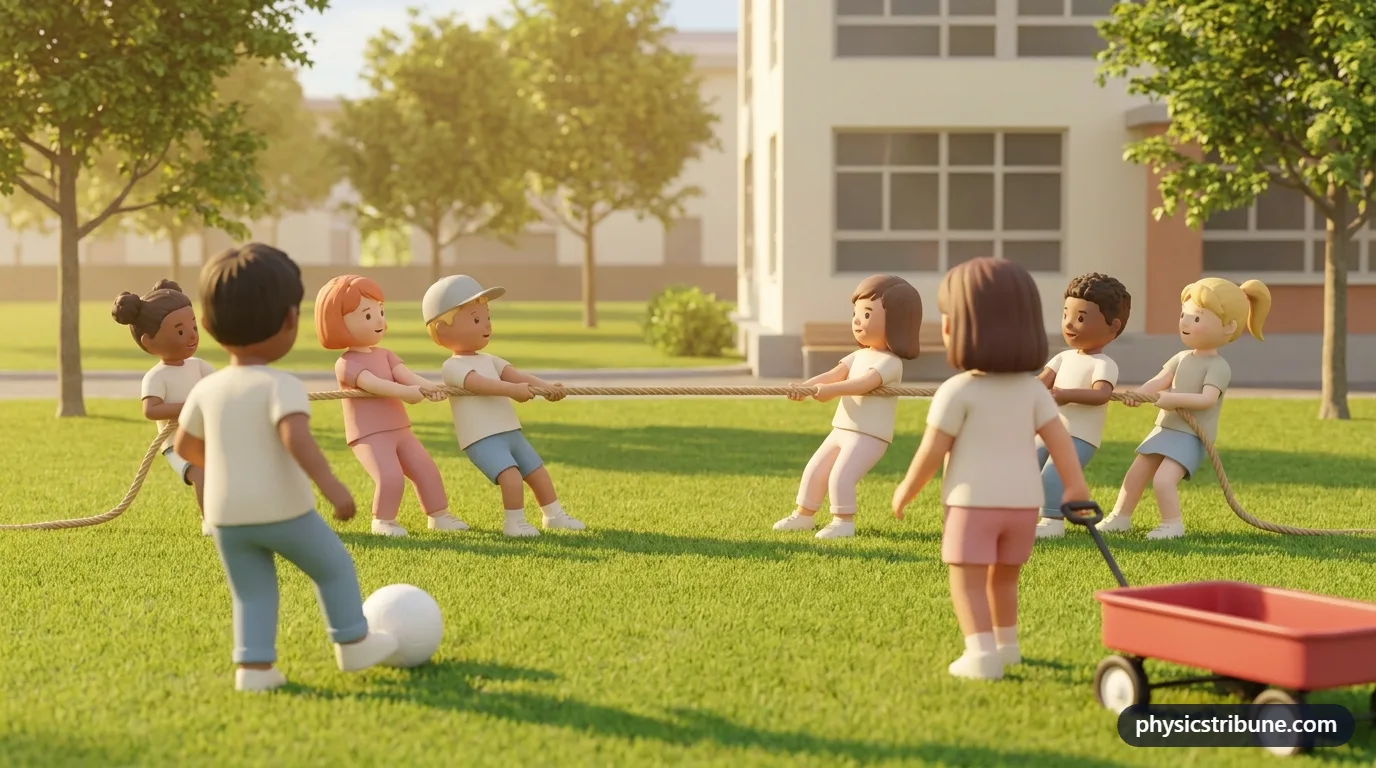
A tug of war is the perfect example. Two teams pull a rope in opposite directions. The middle of the rope shows who is winning.
If both teams pull equally hard, the rope does not move. The forces are balanced. Everyone strains, but nothing changes.
Now one team pulls harder. The forces become unbalanced. The rope slides toward the stronger team, and they win. The table below shows more examples.
| What is happening | Balanced or unbalanced? | Why |
|---|---|---|
| A book resting on a shelf | Balanced | The shelf pushes up as hard as gravity pulls down |
| Two equal teams in a tug of war | Balanced | Both pulls are the same size |
| A car at a steady speed | Balanced | The engine push matches friction and air |
| A ball you just kicked | Unbalanced | Your kick is much stronger |
| A sled starting down a hill | Unbalanced | Gravity pulls it more than friction holds it |
| A bike braking to a stop | Unbalanced | The brakes push back harder |
| Source: Everyday examples · Retrieved October 2026 | ||
Can Something Move When Forces Are Balanced?
Yes, and this surprises many people. Balanced forces do not always mean standing still. They mean no change in motion.
Picture a car cruising down a straight road at a steady speed. The engine pushes it forward. Air and road friction push it back just as hard. The forces balance, so the car keeps the same speed.
If the driver presses the gas, the forward push grows. The forces become unbalanced, and the car speeds up. This idea comes from Newton's laws of motion.
Where Do You See Balanced and Unbalanced Forces?
Look around and you will find both kinds everywhere. Here are some to spot.
- A lamp hanging from the ceiling is balanced. The cord pulls up as hard as gravity pulls down.
- A boat floating still is balanced. Water pushes up as hard as gravity pulls down.
- An apple falling from a tree is unbalanced. Gravity is stronger than the air pushing up.
- A soccer ball that gets kicked is unbalanced. The kick is much bigger than any other force on the ball.
- A bike slowing to a stop is unbalanced. The brakes push back harder than you pedal forward.
Try It at Home: Toy Car Tug of War
You need a toy car, two pieces of string and a smooth table. Ask a friend or grown-up to help.
- Tie one string to the front of the car and one to the back.
- You hold one string, and your helper holds the other.
- Both pull gently with the same strength. Watch the car.
- Now you pull a little harder than your helper.
- Switch, so your helper pulls harder.
When you pull equally, the car stays still. The forces are balanced. When one person pulls harder, the car rolls toward them. The forces are unbalanced.

What Are Some Fun Facts About Balanced Forces?
- A tightrope walker carries a long pole to help keep their balance.
- Tall buildings are designed so wind forces cannot tip them over.
- A hot air balloon floats at one height when its lift balances its weight.
- A falling skydiver stops speeding up when air push matches gravity's pull.
- Even while you sit still, gravity and your chair push on you in balance.
Common Misconceptions
Myth: If forces are balanced, the object cannot be moving.
Physics: Balanced forces mean no change in motion. A car going at a steady speed in a straight line has balanced forces.
Myth: A still object has no forces on it.
Physics: Still objects usually have several forces on them. Those forces just cancel each other out.
Key Facts
- Balanced forces are equal in size and push in opposite directions.
- Balanced forces cancel out, so the motion of an object does not change.
- Unbalanced forces make an object start, stop, speed up, slow down or turn.
- Something can be moving at a steady speed while its forces are balanced.
- A tug of war shows both balanced and unbalanced forces.
Quick Quiz: How Well Do You Know Balanced and Unbalanced Forces for Kids?
5 questions. Tap an answer to check it.
What are balanced forces?
Balanced forces are the same size and point in opposite directions.
A book sits still on a table. Are the forces balanced?
The table pushes up as hard as gravity pulls down.
Which of these shows unbalanced forces?
The kick is stronger than any other force on the ball, so it moves.
A car drives at a steady speed on a straight road. What are its forces?
Steady speed in a straight line means the forces cancel out.
In a tug of war, what makes the rope move?
Uneven pulls are unbalanced, so the rope moves toward the stronger team.
Frequently Asked Questions
What are balanced and unbalanced forces for kids?
Balanced forces are equal pushes or pulls going in opposite directions. They cancel out, so nothing about the motion changes. Unbalanced forces are uneven, so one side wins. Then the object starts moving, stops, speeds up, slows down or turns. A tug of war shows both kinds very clearly.
What is an example of balanced forces?
A picture hanging on a wall is a good example. Gravity pulls it down, and the nail and string pull it up just as hard. The forces cancel, so the picture stays still. A calm floating boat is another example. So are two equal tug of war teams.
What is an example of unbalanced forces?
Kicking a soccer ball is an example. Your foot pushes harder than any other force on the ball. The forces are unbalanced, so the ball flies off. A falling leaf has unbalanced forces too. So does a car speeding up.
How can you tell if forces are balanced?
Watch the motion. Does the object stay still or keep the same speed in a straight line? Then the forces are balanced. If it starts, stops, speeds up, slows down or turns, the forces are unbalanced. A change in motion always means one force is winning.
Do balanced forces make things move?
No, balanced forces cannot start or change motion. A still object stays still. But a moving object with balanced forces keeps moving at the same speed. Only unbalanced forces can make it speed up, slow down or change direction.
What happens when forces are unbalanced?
The object's motion changes in the direction of the stronger force. A resting toy starts rolling. A rolling toy might speed up, slow down or turn. The bigger the difference between the forces, the bigger and faster the change. A tiny difference makes only a small change.