
At a Glance
A flat coil carrying current in a uniform magnetic field feels a torque τ = N I A B sin θ, where N is the number of turns, I the current, A the loop area, B the field and θ the angle between the field and a line perpendicular to the loop. The torque is largest when the field lies in the plane of the loop and zero when the loop faces the field squarely.
- Symbol
- τ (tau)
- SI unit
- newton meter (N·m)
- Formula
- τ = NIAB sin θ
- Magnetic moment
- μ = NIA, so τ = μB sin θ
- Scalar or vector
- Vector (τ = μ × B), along the rotation axis
- Depends on
- Turns, current, area, field strength and angle
On this page
- What Is the Torque on a Current Loop?
- Torque on a Current Loop Explained Simply
- Where Does the Torque Come From?
- What Is the Formula for Torque on a Current Loop?
- How Does the Angle Change the Torque?
- What Is the Magnetic Moment of a Loop?
- How Do Motors and Meters Use This Torque?
- How Can You Increase the Torque on a Coil?
- Going Deeper: Energy of a Loop in a Field
- Practice Torque and Magnetism Problems
- Common Misconceptions
- Key Facts
- Quiz
- FAQ
What Is the Torque on a Current Loop?
When a closed loop of wire carries current inside a magnetic field, the field pushes on the wire. For a loop, those pushes do not move the loop as a whole in a uniform field; instead they try to twist it about an axis. That twisting effect is the torque on a current loop.
The loop keeps turning until it faces the field squarely, with the field passing straight through it. At that position the twist vanishes. A loop with many turns, a large area or a strong current twists harder, and so does a loop placed in a stronger field.
This simple effect drives a huge range of machines. Electric motors in fans, drills and cars, along with classic analog dial meters, all rely on it. To review torque in general, see our torque page.
Torque on a Current Loop Explained Simply
Picture a rectangular loop of wire lying between the poles of a horseshoe magnet. Current flows up one side of the loop and down the other. The magnet pushes the first side one way and the second side the opposite way, like two hands turning a steering wheel.
Those opposite pushes do not cancel each other's turning effect. They add up, so the loop rotates. Once the loop has turned to face the magnet's poles head-on, the pushes line up along the same line and the twisting stops. A motor's job is to keep the loop from settling there, so it keeps on spinning.

Where Does the Torque Come From?
Each straight side of the loop is a current-carrying wire, and a magnetic field pushes on it with a force
Two equal, opposite forces acting along different lines form a couple. A couple has no net force, so the loop does not slide anywhere, but it does have a net torque. The other two sides of the loop also feel forces, but those point along the rotation axis and cancel without producing any twist.
You can find the direction of each force with the right-hand rule or Fleming's left-hand rule. The same physics, applied to a whole motor, is called the motor effect.
What Is the Formula for Torque on a Current Loop?
Adding up the torque from both sides of a flat loop gives
The result does not depend on the loop's shape, only on its area, as long as the loop is flat and the field is uniform. A circle, a square and a rectangle with the same area and the same current feel the same torque. Each extra turn adds another identical loop, which is why N simply multiplies the answer.
For other kinds of torque problems, such as wrenches, doors and seesaws, use our torque calculator.
Here is the torque formula with each variable and its SI unit, plus the forms for finding the field or the current.
| Symbol | Quantity | SI unit |
|---|---|---|
| torque | newton meter (N·m) | |
| number of turns | dimensionless (1) | |
| current | ampere (A) | |
| loop area | square meter (m²) | |
| magnetic field | tesla (T) | |
| angle between the loop normal and B | radian (rad) |
Rearranged to find another variable:
Valid for: flat loop in a uniform field.
Example 1 Maximum torque on a small motor coil
A rectangular coil of 200 turns measures 4 cm by 6 cm (area 0.0024 m²) and carries 0.5 A. It sits in a 0.3 T field with the field lying in the plane of the coil, so θ = 90°. What torque acts on it?
- Given:
- number of turns:
- current:
- loop area:
- magnetic field:
- angle between the loop normal and B:
- number of turns:
- Formula:
- Substitute:
- Answer:
That is roughly the twist your fingers apply when turning a small key, enough to spin a toy motor's shaft.
How Does the Angle Change the Torque?
The
The position where the torque is zero and the loop faces the field is a stable resting point. Nudge the loop a little and the torque pulls it back, like a compass needle settling on north. The opposite orientation,
The table shows how the torque on the coil from the first worked example changes as it rotates.
Example 2 The same coil partway through a turn
The coil from the first example has rotated so that its normal now makes 30° with the field. Everything else is unchanged: 200 turns, 0.0024 m², 0.5 A, 0.3 T. What is the torque now?
- Given:
- number of turns:
- current:
- loop area:
- magnetic field:
- angle between the loop normal and B:
- number of turns:
- Formula:
- Substitute:
- Answer:
Because sin 30° is one half, the torque has dropped to half its peak value as the coil nears its resting position.
| Angle θ between normal and field | sin θ | Torque (N·m) | Share of maximum |
|---|---|---|---|
| 0° | 0 | 0 | 0% (stable rest) |
| 30° | 0.500 | 0.036 | 50% |
| 45° | 0.707 | 0.0509 | 70.7% |
| 60° | 0.866 | 0.0624 | 86.6% |
| 90° | 1 | 0.072 | 100% (maximum) |
| 120° | 0.866 | 0.0624 | 86.6% |
| 150° | 0.500 | 0.036 | 50% |
| 180° | 0 | 0 | 0% (unstable rest) |
| Source: Computed with τ = NIAB sin θ · Retrieved October 2026 | |||
What Is the Magnetic Moment of a Loop?
The product
The magnetic moment points along the loop's normal, in the direction your right thumb points when your fingers curl with the current. A current loop then behaves exactly like a tiny bar magnet with its north pole on the thumb side. That is why the loop turns to line up with the field, just as a compass needle does. The field around a current loop even looks like the field of a short bar magnet, shown below.
The idea scales down to atoms. Electrons carry a built-in magnetic moment, and the alignment of countless atomic moments is what makes iron magnetic. The field produced by the loop itself is a separate topic, covered on the magnetic field of a current loop page.

How Do Motors and Meters Use This Torque?
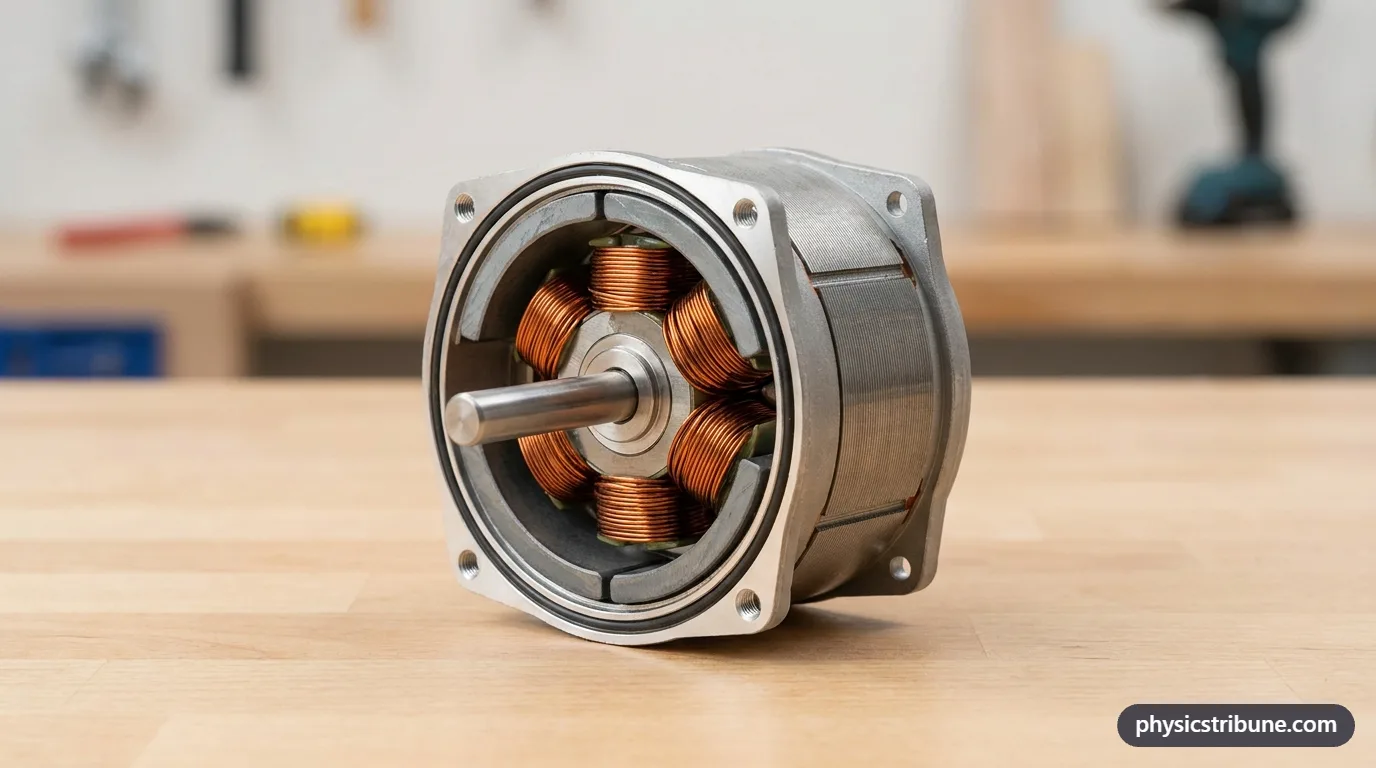
In a DC electric motor, a coil sits between magnets and the torque turns it. Left alone, the coil would swing to its stable position and stop, because the torque reverses direction every half turn, as the graph shows. A split-ring commutator fixes this by flipping the current in the coil at just the right moment, so the torque always pushes the same way and the shaft keeps turning.
A moving-coil meter uses the same torque more gently. Its coil is attached to a pointer and a hairspring. The magnetic torque, proportional to the current, twists the coil until the spring's opposing torque balances it, so the pointer angle shows the current. This design was the basis of the analog ammeter and voltmeter for more than a century.
Example 3 Finding the field inside a meter
A moving-coil meter has 50 turns on a coil of area 0.0006 m². When 12 mA flows, the magnetic torque on the coil is 1.8 × 10⁻⁴ N·m, with the field always lying in the plane of the coil (θ = 90°). How strong is the meter's magnetic field?
- Given:
- torque:
- number of turns:
- current:
- loop area:
- angle between the loop normal and B:
- torque:
- Formula:
- Substitute:
- Answer:
Curved pole pieces keep the field in the plane of the coil at every position, so the torque, and the needle's swing, stay proportional to the current.

How Can You Increase the Torque on a Coil?
Every factor in the formula is a design knob, and real devices turn several of them at once:
- More turns. Winding more wire multiplies the torque directly, though it also adds resistance and weight.
- More current. Torque grows in proportion to the current, which is why a motor strains harder when you raise the supply voltage.
- Larger area. A wider coil has longer lever arms for the forces on its sides.
- Stronger field. Neodymium magnets and iron pole pieces raise B, a key reason modern motors are so compact.
- Better angle. Curved poles with an iron core keep the field in the plane of the coil, holding
| Change | New torque |
|---|---|
| Double the number of turns N | 2 × original |
| Double the current I | 2 × original |
| Double the side lengths of a square coil | 4 × original (area is 4 ×) |
| Double the field B | 2 × original |
| Turn from θ = 90° to θ = 30° | 0.5 × original |
| Reverse the current | Same size, opposite direction |
| Source: Computed from τ = NIAB sin θ · Retrieved October 2026 | |
Going Deeper: Energy of a Loop in a Field
A current loop in a magnetic field has a potential energy that depends on its orientation,
This energy picture is central in atomic physics. The magnetic moments of protons in the body have slightly different energies when aligned with or against a strong field, and an MRI scanner detects the radio signals given off when they flip between those states. The French scientist André-Marie Ampère was among the first to propose that magnetism in materials comes from tiny circulating currents, an idea this formula makes precise.
Practice Torque and Magnetism Problems
Work through printable problems with answer keys in our magnetism worksheets and torque worksheets. The magnetism formula sheet lists this formula alongside the force on a wire and the fields of wires and coils. Then try the quiz below.
Common Misconceptions
Myth: A current loop in a uniform field is pulled toward the magnet.
Physics: In a uniform field the forces on opposite sides cancel, so there is no net force. The loop only twists. A net pull appears only where the field is non-uniform.
Myth: The torque is largest when the loop faces the magnet's poles.
Physics: Facing the poles means the field passes straight through the loop, θ = 0, where the torque is zero. Maximum torque happens when the field lies in the loop's plane.
Myth: A bigger torque needs a particular loop shape, like a circle.
Physics: For a flat loop in a uniform field, only the area counts. Any shape with the same area, turns and current feels the same torque.
Myth: Without a commutator a coil would still spin steadily in a DC motor.
Physics: The torque reverses every half turn, so the coil would rock back and forth and settle at its stable position. The commutator flips the current to keep it turning.
Key Facts
- A current loop in a uniform magnetic field feels a torque but no net force.
- The torque is τ = NIAB sin θ, where θ is the angle between the field and the loop's normal.
- Torque is greatest when the field lies in the plane of the loop and zero when the field passes straight through it.
- The magnetic dipole moment of a loop is μ = NIA, so τ = μB sin θ.
- Only the loop's area matters, not its shape, for a flat loop in a uniform field.
- Electric motors use a commutator to reverse the current every half turn, keeping the torque in one direction.
- Moving-coil meters balance the magnetic torque against a spring, so the pointer angle shows the current.
Quick Quiz: How Well Do You Know Torque on a Current Loop?
6 questions. Tap an answer to check it.
At what angle between the loop's normal and the field is the torque largest?
sin 90° = 1, so the torque reaches its maximum value NIAB.
What is the net force on a current loop in a uniform magnetic field?
Forces on opposite sides are equal and opposite, so they cancel; only a torque remains.
If the number of turns on a coil doubles while everything else stays the same, the torque…
N multiplies the torque directly, so twice the turns gives twice the torque.
What is the magnetic dipole moment of a 10-turn coil of area 0.01 m² carrying 2 A?
μ = NIA = 10 × 2 × 0.01 = 0.2 A·m².
What part of a DC motor keeps the torque pointing in one direction?
The commutator reverses the coil current every half turn so the torque never reverses.
Which change would NOT increase the torque on a coil at θ = 90°?
For a flat loop in a uniform field, only the area matters, not the shape.
Frequently Asked Questions
What is the formula for torque on a current loop?
The torque is τ = NIAB sin θ. N is the number of turns, I is the current in amperes, A is the loop area in square meters, B is the magnetic field in teslas and θ is the angle between the field and the line perpendicular to the loop. The answer comes out in newton meters. Writing μ = NIA shortens it to τ = μB sin θ.
When is the torque on a current loop maximum?
The torque is greatest when θ = 90°, which means the magnetic field lies flat in the plane of the loop. At that angle sin θ equals 1, so τ = NIAB. In this position the forces on the two active sides of the loop act along lines that are as far apart as possible, giving the biggest lever arm.
When is the torque on a current loop zero?
The torque is zero when θ = 0° or θ = 180°, meaning the field passes straight through the loop. At 0° the loop is in stable equilibrium and returns there if disturbed. At 180° it is in unstable equilibrium, and any small push makes it flip around. A motor coil would come to rest at the stable position without a commutator.
Why is there no net force on a current loop in a uniform field?
Opposite sides of a closed loop carry current in opposite directions, so the field pushes them with equal forces in opposite directions. Those forces add to zero, which means the loop as a whole does not accelerate. Because the two main forces act along different lines, though, they still produce a turning effect, which is the torque.
What is the magnetic dipole moment of a current loop?
The magnetic dipole moment is μ = NIA, the number of turns times the current times the area. Its unit is the ampere square meter. It points perpendicular to the loop, following the right-hand rule. The moment tells you how strongly the loop responds to a field, since the torque is simply μB sin θ.
How does a DC motor use torque on a current loop?
A DC motor places a coil between magnets so that the current through it produces a torque. On its own, that torque would reverse after half a turn and stop the coil. A split-ring commutator reverses the current at that moment, so the torque keeps pointing the same way and the shaft keeps rotating smoothly.
Does the shape of the loop matter?
For a flat loop in a uniform magnetic field, no. The torque depends only on the area enclosed by the loop, together with the turns, current, field and angle. A circular coil and a square coil of equal area give the same torque. Shape starts to matter only when the field changes noticeably across the loop.
What unit is torque on a current loop measured in?
Torque is measured in newton meters, written N·m. Checking the units of NIAB confirms this: amperes times square meters times teslas gives newton meters, because one tesla equals one newton per ampere per meter. Although the newton meter matches the joule dimensionally, torque is not energy, so we keep the N·m form.
Keep Exploring
 magnetismHow Electric Motors Work
 magnetismMagnetic Force on a Current-Carrying Wire
 rotationTorque (Moment of a Force)
 magnetismThe Motor Effect
 calculatorsTorque Calculator (Physics)
 magnetismMagnetic Field of a Current Loop
 worksheetsMagnetism Worksheets
 electricityAmmeters and Voltmeters
 physicistsAndré-Marie Ampère
Sources
Constants come from NIST CODATA 2022 (public domain) and unit definitions from the BIPM SI Brochure (CC BY 4.0). Text, diagrams and illustrations are original work by Physics Tribune.