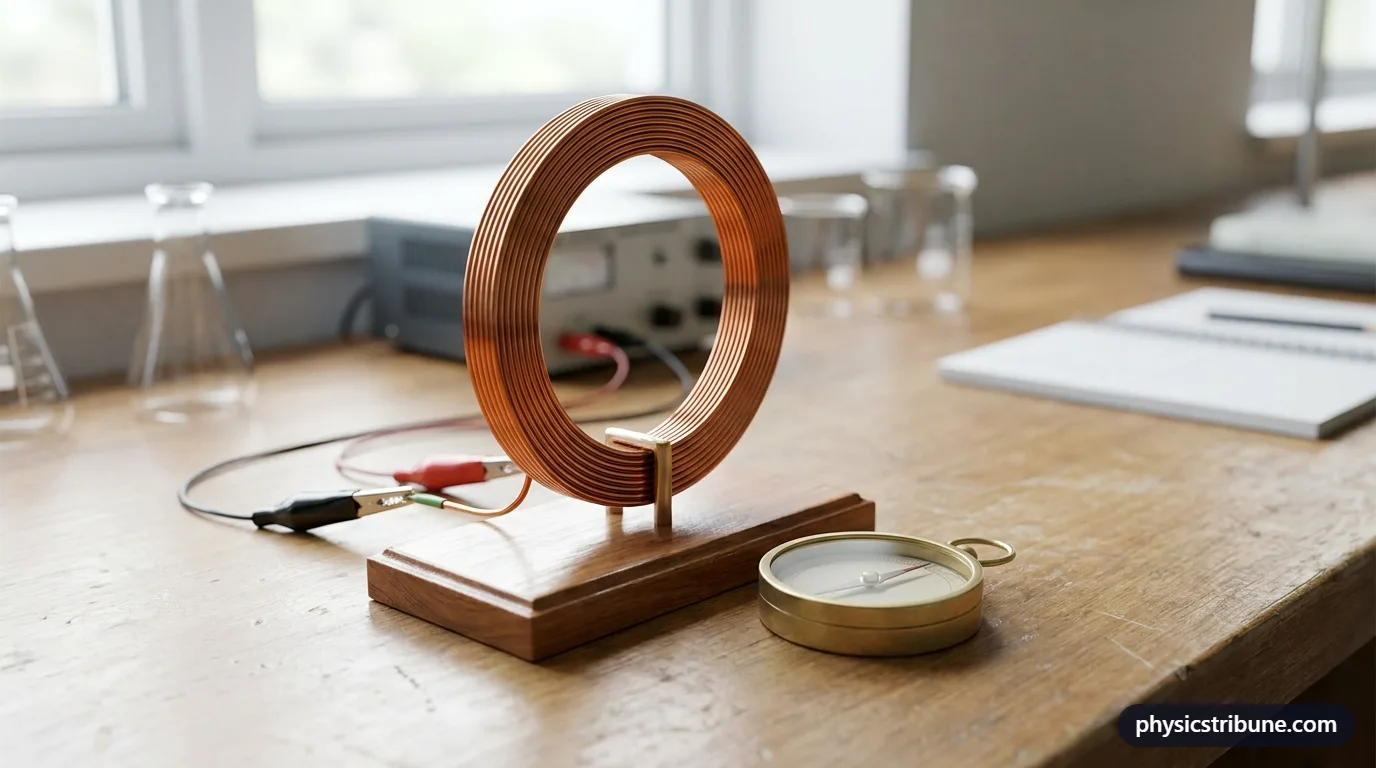
At a Glance
The Biot-Savart law says a current element I dl produces a magnetic field dB = (μ0/4π) I dl × r̂ / r², with magnitude (μ0/4π) I dl sin θ / r². The field is in tesla, μ0 = 1.25663706127 × 10⁻⁶ T·m/A, and the full field of a wire or loop is found by adding (integrating) the contributions of every element.
- Discovered by
- Jean-Baptiste Biot and Félix Savart
- Year
- 1820, a few months after Ørsted's compass discovery
- Formula
- dB = (μ0/4π) I dl × r̂ / r²
- Field direction
- Perpendicular to both the current element and the line to the point (right-hand rule)
- Distance dependence
- Inverse square for each element
- Applies to
- Steady currents (magnetostatics), in vacuum or air
On this page
- What Does the Biot-Savart Law Say?
- The Biot-Savart Law Explained Simply
- What Is the Biot-Savart Law Formula?
- How Do You Use the Biot-Savart Law for a Wire or a Loop?
- Who Discovered the Biot-Savart Law?
- Where Is the Biot-Savart Law Used?
- How Is the Biot-Savart Law Related to Ampère's Law?
- What Are the Limits of the Biot-Savart Law?
- Practice Magnetic Field Problems
- Common Misconceptions
- Key Facts
- Quiz
- FAQ
What Does the Biot-Savart Law Say?
The Biot-Savart law is a recipe for the magnetic field of a current. It breaks the wire into tiny pieces, called current elements, and tells you the field that each piece makes at a chosen point. The total field is then the sum of all those small contributions, a property called superposition.
Each contribution follows three rules. It is proportional to the current and to the length of the piece. It falls off as one over the square of the distance, just like the electric field of a point charge in Coulomb's law. And it points sideways, at right angles to both the wire piece and the line joining the piece to the point.
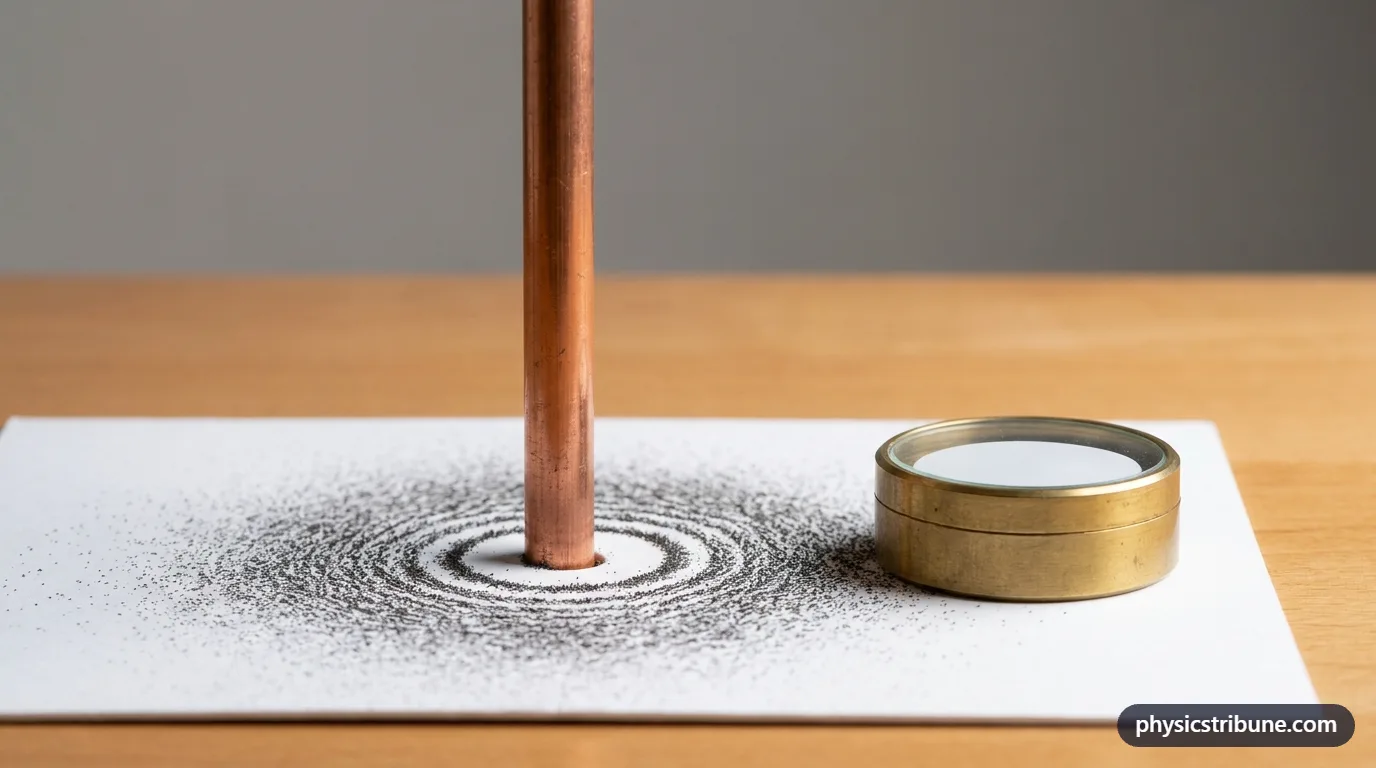
That sideways direction is what makes magnetism look so different from electricity. Field lines around a straight wire do not point toward or away from it; they wrap around it in circles, which you can see in the diagram below and on our magnetic field lines page.

The Biot-Savart Law Explained Simply
Think of a long garden hose with water flowing through it, and imagine each short section of the hose stirring up a little swirl in the air around it. The swirl from each section is strongest close by and fades quickly with distance. Stand anywhere near the hose and the swirl you feel is the combined effect of every section.
The Biot-Savart law says a current works in a similar way. Every bit of wire adds a small magnetic swirl around itself. More current means a stronger swirl; twice the distance means a quarter of the contribution. Bits of wire pointing straight at you add nothing, while bits running crosswise to your line of sight add the most.
For a straight wire, a ring or a coil, you just have to add the swirls carefully. That adding is the hard part, and it usually needs calculus.
What Is the Biot-Savart Law Formula?
In vector form the law is
For magnitudes you can replace the cross product with a sine:
The constant in front,
Here is the Biot-Savart law with each quantity and its SI unit. The cross product makes the field perpendicular to both the current element and the direction to the point.
| Symbol | Quantity | SI unit |
|---|---|---|
| field contribution of the current element | tesla (T) | |
| permeability of free space (4π × 10⁻⁷ T·m/A (approximately; 1.2566 × 10⁻⁶ T·m/A)) | tesla meter per ampere (T·m/A) | |
| current | ampere (A) | |
| current element (length in direction of current) | meter (m) | |
| distance from the element to the field point | meter (m) |
Valid for: steady currents; magnitude dB = (μ0/4π) I dl sin θ / r².
Example 1 One short piece of a wire
A wire carries 10 A. Consider a 0.002 m piece of it and a point 0.05 m away, on a line perpendicular to that piece. Using μ0 = 1.25663706127 × 10⁻⁶ T·m/A, how large is the field contribution from that piece alone?
- Given:
- current:
- current element (length in direction of current):
- distance from the element to the field point:
- current:
- Formula:
- Substitute:
- Answer:
A tiny contribution on its own. The full field of the wire is the sum of thousands of pieces like this.
Example 2 The same piece seen at an angle
Keep the same 10 A current, 0.002 m piece and 0.05 m distance, but now the line to the point makes a 30° angle with the direction of the current. Using μ0 = 1.25663706127 × 10⁻⁶ T·m/A, what is the field contribution?
- Given:
- current:
- current element (length in direction of current):
- distance from the element to the field point:
- θ:
- current:
- Formula:
- Substitute:
- Answer:
Since sin 30° is one half, the contribution halves. A point straight along the line of the current (θ = 0) gets no field at all from that piece.
How Do You Use the Biot-Savart Law for a Wire or a Loop?
The law becomes powerful once you add up the elements for a whole shape. Two results come up again and again:
- A long straight wire. Summing every element from one end to the other gives
- The center of a circular loop. Every element of a ring is the same distance from the center and at right angles to the radius, so all contributions point the same way and add simply:
Along the axis of a loop, the field also has a neat closed form,
Example 3 Field at the center of a wire ring
A single circular loop of wire with a radius r of 0.04 m carries 3 A. Adding up the Biot-Savart contributions of the whole ring gives B = μ0 I / (2r) at its center. Using μ0 = 1.25663706127 × 10⁻⁶ T·m/A, what is the field there?
- Given:
- current:
- distance from the element to the field point:
- current:
- Formula:
- Substitute:
- Answer:
That is roughly Earth's surface field from a single turn. Wind 100 turns and the field at the center grows a hundredfold.
| Distance from center z (m) | z in loop radii | Field B (µT) | Share of center field |
|---|---|---|---|
| 0 | 0 | 25.13 | 100% |
| 0.025 | 0.5 | 17.98 | about 72% |
| 0.05 | 1 | 8.886 | about 35% |
| 0.1 | 2 | 2.248 | about 9% |
| 0.2 | 4 | 0.3586 | about 1.4% |
| Source: Computed with B = μ0 I r² / (2(r² + z²)^(3/2)), μ0 = 1.25663706127 × 10⁻⁶ N/A² (NIST CODATA 2022) · Retrieved October 2026 | |||

Who Discovered the Biot-Savart Law?
In 1820 Hans Christian Ørsted announced that an electric current turns a nearby compass needle. The news spread across Europe within weeks, and two French scientists, the physicist Jean-Baptiste Biot and his younger colleague Félix Savart, set out to measure the effect.
They hung a small magnetized needle near a long vertical wire and timed how fast it oscillated at different distances. A faster oscillation meant a stronger field. Their measurements, reported later that same year, showed that the field of a long straight wire is inversely proportional to the distance from it.
The step from that result to a rule for a single tiny piece of wire is usually credited to the mathematician Pierre-Simon Laplace, and some textbooks still call the element form Laplace's law. At about the same time André-Marie Ampère was working out the forces between currents, work that led to Ampère's law.
Where Is the Biot-Savart Law Used?
- Designing coils. Engineers calculate the field of solenoids, MRI magnets and particle-beam steering magnets by summing Biot-Savart contributions, often with computer programs that split the windings into thousands of elements.
- Helmholtz coils. Two identical loops spaced one radius apart produce an unusually uniform field in the middle, a result that falls straight out of the on-axis loop formula.
- Sensors and shielding. Knowing the field of a power cable or a circuit trace helps designers keep it away from compasses, magnetometers and sensitive electronics.
- Fluid flow. The same mathematics describes the swirling flow induced around a vortex line in air or water, which is why aerodynamicists also talk about a Biot-Savart law for wing-tip vortices.

How Is the Biot-Savart Law Related to Ampère's Law?
Both laws describe the magnetic field of steady currents, and each can be derived from the other. The Biot-Savart law works for any shape of circuit, but the sums can be long. Ampère's law uses a clever closed path around the current and gives the answer in one line, but only for highly symmetric shapes such as long straight wires, long solenoids and toroids.
A good rule of thumb: reach for Ampère's law when symmetry makes the field constant along a loop, and use Biot-Savart for everything else. For a finite wire, a square loop or the field off the axis of a ring, Biot-Savart is the only practical choice.
What Are the Limits of the Biot-Savart Law?
The law in this form is exact for steady currents, the subject called magnetostatics. When currents change quickly, as in an antenna, the field at a distance depends on what the current was doing a moment earlier, because changes travel outward at the speed of light. Full electromagnetic theory then replaces the simple law.
The law also assumes empty space, or air, which is almost the same. Inside iron or other magnetic materials the field is changed by the material's own magnetization, a topic covered on our ferromagnetism page.
Finally, a single current element cannot exist on its own, because charge cannot pile up at the ends of an isolated piece of wire. Only complete circuits are physical, and the law is always applied by summing around a whole closed path.
Practice Magnetic Field Problems
Our magnetism worksheets include wire and loop field problems with answer keys. Check your answers with the magnetic field calculator, and find every related equation on the magnetism formulas sheet.
Common Misconceptions
Myth: The magnetic field of a current points toward or away from the wire.
Physics: The field is perpendicular to the current and to the line to the point, so around a straight wire it circles the wire.
Myth: Since each element follows an inverse-square law, a long wire's field also falls as 1/r².
Physics: Adding all the elements of a long straight wire gives a field that falls only as 1/r. The shape of the circuit changes the overall distance dependence.
Myth: Every part of a wire contributes equally to the field at a point.
Physics: Closer elements and elements running crosswise to the line of sight contribute much more; elements pointing straight at the point contribute nothing.
Key Facts
- The Biot-Savart law gives the magnetic field produced by each small piece of a steady current.
- Each contribution is proportional to the current and the element length and falls off as 1/r².
- The field from an element points perpendicular to both the element and the line to the point.
- A current element produces no field along its own line, because sin 0° = 0.
- Summing the contributions gives B = μ0I/(2πr) for a long straight wire and B = μ0I/(2r) at the center of a loop.
- Jean-Baptiste Biot and Félix Savart reported their measurements in 1820, the same year as Ørsted's discovery.
- The law plays the same role for magnetism that Coulomb's law plays for electricity.
Quick Quiz: How Well Do You Know Biot-Savart Law?
6 questions. Tap an answer to check it.
According to the Biot-Savart law, doubling the distance from a current element changes its field contribution by a factor of
Each element follows an inverse-square law, so twice the distance gives one quarter.
In which direction does the field from a current element point?
The cross product makes the field perpendicular to both directions.
A point lies exactly along the line of a straight current element. Its field contribution there is
The angle is 0°, and sin 0° = 0.
What is the field at the center of a single loop of radius r carrying current I?
All elements of the ring contribute in the same direction, giving μ0I/(2r).
What happens to the field at a fixed point if the current in the circuit triples?
Every contribution is proportional to I, so the total triples.
Whose 1820 discovery prompted Biot and Savart's experiments?
Ørsted showed that a current deflects a compass needle.
Frequently Asked Questions
What is the Biot-Savart law in simple terms?
It is a rule for finding the magnetic field made by an electric current. You split the wire into tiny pieces, work out the small field each piece makes at your point, and add them all up. Each piece's field grows with the current, shrinks with the square of the distance, and points sideways around the wire.
What is the formula for the Biot-Savart law?
In vector form, dB = (μ0/4π) I dl × r̂ / r². For the size alone, dB = (μ0/4π) I dl sin θ / r², where I is the current, dl is a small length of wire, r is the distance to the point and θ is the angle between the wire and the line to the point. The constant μ0/4π is very close to 10⁻⁷ T·m/A.
What is the Biot-Savart law used for?
It is used to calculate the magnetic field of any current-carrying conductor: straight wires, rings, coils, circuit board traces and the windings of large magnets. Engineers rely on it to design MRI magnets, Helmholtz coils and particle accelerator magnets, and to check how much field a power cable creates near sensitive equipment.
Why is there a cross product in the Biot-Savart law?
The cross product captures two experimental facts. The field from a current element points perpendicular to both the element and the line to the point, and its size depends on the sine of the angle between them. A cross product does exactly that, giving a vector at right angles to both inputs, with a length that includes the sine of the angle.
What is the difference between the Biot-Savart law and Ampère's law?
Both give the magnetic field of steady currents. The Biot-Savart law works for any circuit shape by adding up contributions from every piece of wire. Ampère's law relates the field around a closed path to the current passing through it, and it gives quick answers only when symmetry makes the field constant along that path.
How is the Biot-Savart law similar to Coulomb's law?
Both are inverse-square laws for a small source: a point charge in Coulomb's law and a current element in the Biot-Savart law. Both use superposition to build up the field of larger objects. The key difference is direction, since an electric field points radially from a charge while the magnetic field of a current element points sideways.
Does the Biot-Savart law work for changing currents?
Only approximately. The law is exact for steady currents. When a current changes slowly compared with the time light takes to cross the circuit, it still works very well, which covers household wiring. For fast changes, such as radio antennas, the delay in how changes spread must be included using the full theory of electromagnetism.
Who were Biot and Savart?
Jean-Baptiste Biot was a French physicist, astronomer and mathematician known for work on optics, meteorites and electromagnetism. Félix Savart was a French physicist and physician who studied acoustics as well as magnetism. Together, in 1820, they measured the magnetic field around a long current-carrying wire and showed that it weakens in proportion to distance.
Keep Exploring
 magnetismAmpère's Law
 magnetismMagnetic Field of a Straight Wire
 magnetismMagnetic Field of a Current Loop
 magnetismRight-Hand Rule
 constantsPermeability of Free Space (μ₀)
 electricityCoulomb's Law
 calculatorsMagnetic Field Calculator (wire, solenoid)
 worksheetsMagnetism Worksheets
 physicistsHans Christian Ørsted
Sources
Constants come from NIST CODATA 2022 (public domain) and unit definitions from the BIPM SI Brochure (CC BY 4.0). Text, diagrams and illustrations are original work by Physics Tribune.