At a Glance
A real image is made where light rays truly converge, can be caught on a screen and is usually inverted. A virtual image is made where rays only seem to diverge from, cannot be projected and is usually upright. In the lens and mirror equation 1/f = 1/d_o + 1/d_i, a positive d_i means real and a negative d_i means virtual.
- Real image
- Rays actually meet; can be shown on a screen
- Virtual image
- Rays only appear to meet; seen only by looking into the device
- Usual orientation
- Real: inverted · Virtual: upright (single lens or mirror)
- Sign of di
- Real: positive · Virtual: negative
- Sign of magnification m
- Real: negative · Virtual: positive
- Key equation
- 1/f = 1/do + 1/di
On this page
- What Are Real and Virtual Images?
- Real and Virtual Images Explained Simply
- How Is a Real Image Formed?
- How Is a Virtual Image Formed?
- How Can You Tell if an Image Is Real or Virtual?
- How Does the Lens Equation Show Real or Virtual Images?
- Which Images Do Convex and Concave Lenses Form?
- Which Images Do Plane, Concave and Convex Mirrors Form?
- What Are Everyday Examples of Real and Virtual Images?
- Who First Explained How the Eye Forms a Real Image?
- How Can You Practice Real and Virtual Image Problems?
- Common Misconceptions
- Key Facts
- Quiz
- FAQ
What Are Real and Virtual Images?
An image is the copy of an object that a lens or mirror produces. Every point on the object sends out light, and the optical device redirects that light so it seems to come from a new set of points. Those new points make up the image.
The difference between the two kinds lies in what the light actually does. For a real image, rays from each object point really cross at one spot in space. For a virtual image, the rays leaving the device spread apart, and your brain traces them back in straight lines to a spot they never reached.
That one difference decides everything else: whether you can project the image, which way up it appears and what sign it gets in the equations. If you want the two side by side in a single table, our real vs virtual image comparison lays them out row by row.
Real and Virtual Images Explained Simply
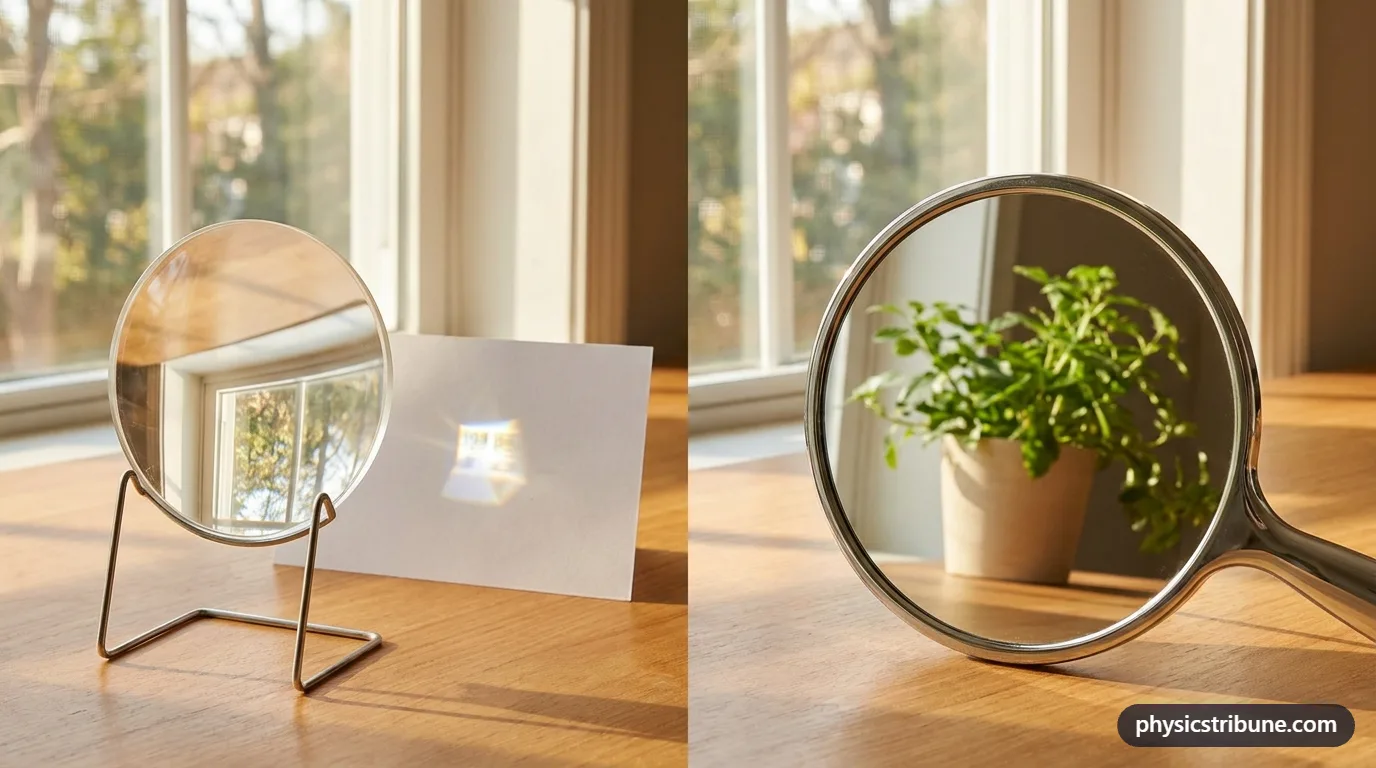
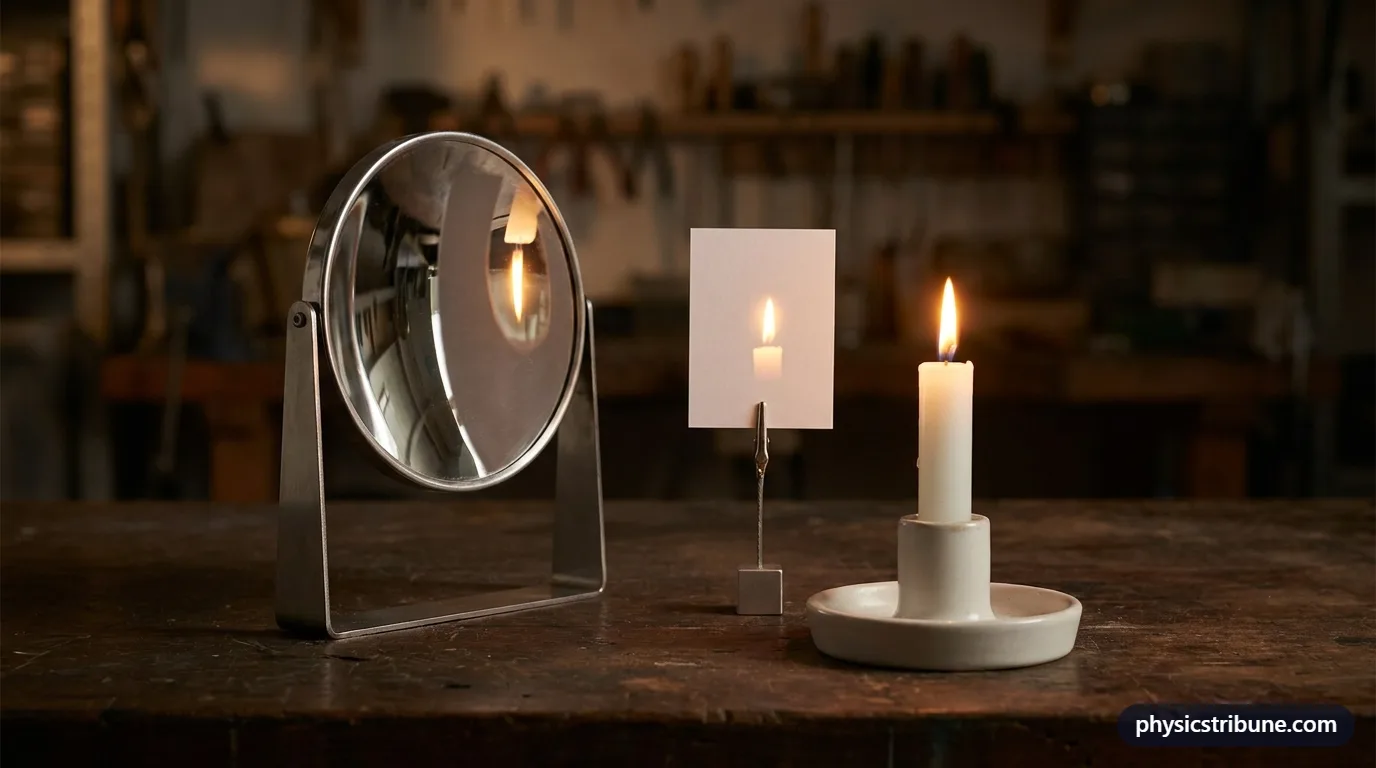
Think of light rays as many straight lines leaving the tip of a candle flame. A magnifying glass held the right way bends all of those lines so they meet again at one point on a sheet of paper. Light really arrives there, so a tiny bright flame appears on the paper. That is a real image.
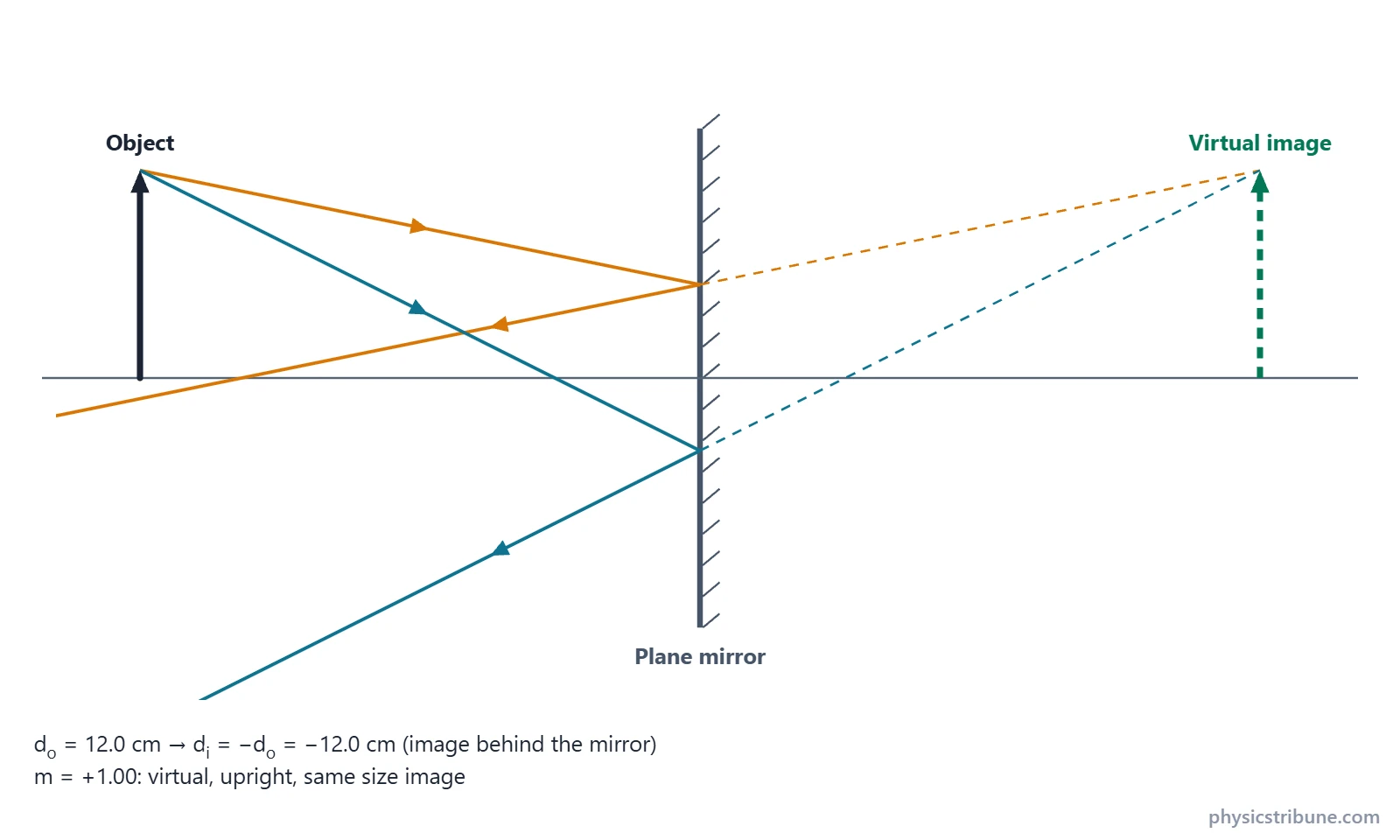
Now look at yourself in a flat mirror. The light bounces off the glass and comes toward your eyes. Your eyes assume light travels straight, so they place you somewhere behind the glass. No light ever goes back there. That is a virtual image.
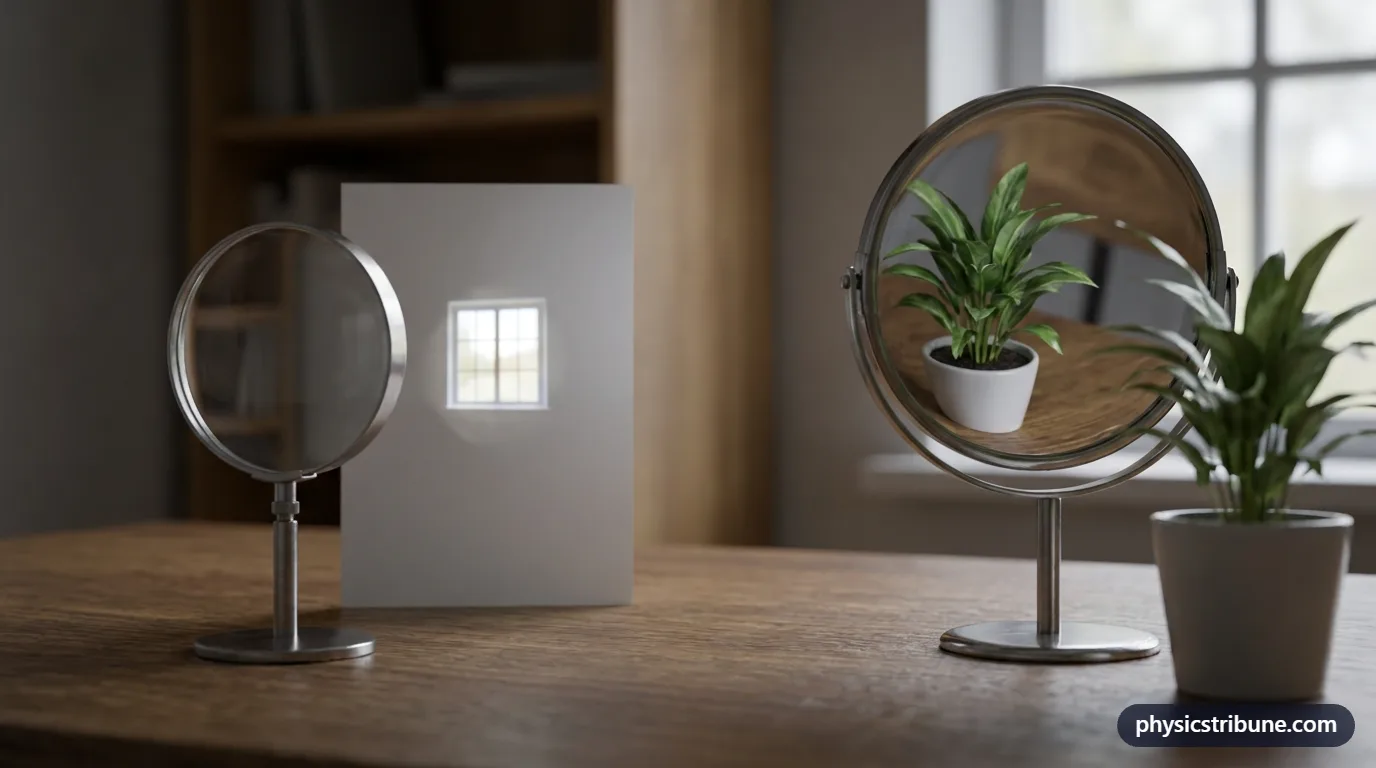
A simple test sums it up. If you can catch the picture on a white card, it is real. If you can only see it by looking into the lens or mirror, it is virtual.
How Is a Real Image Formed?
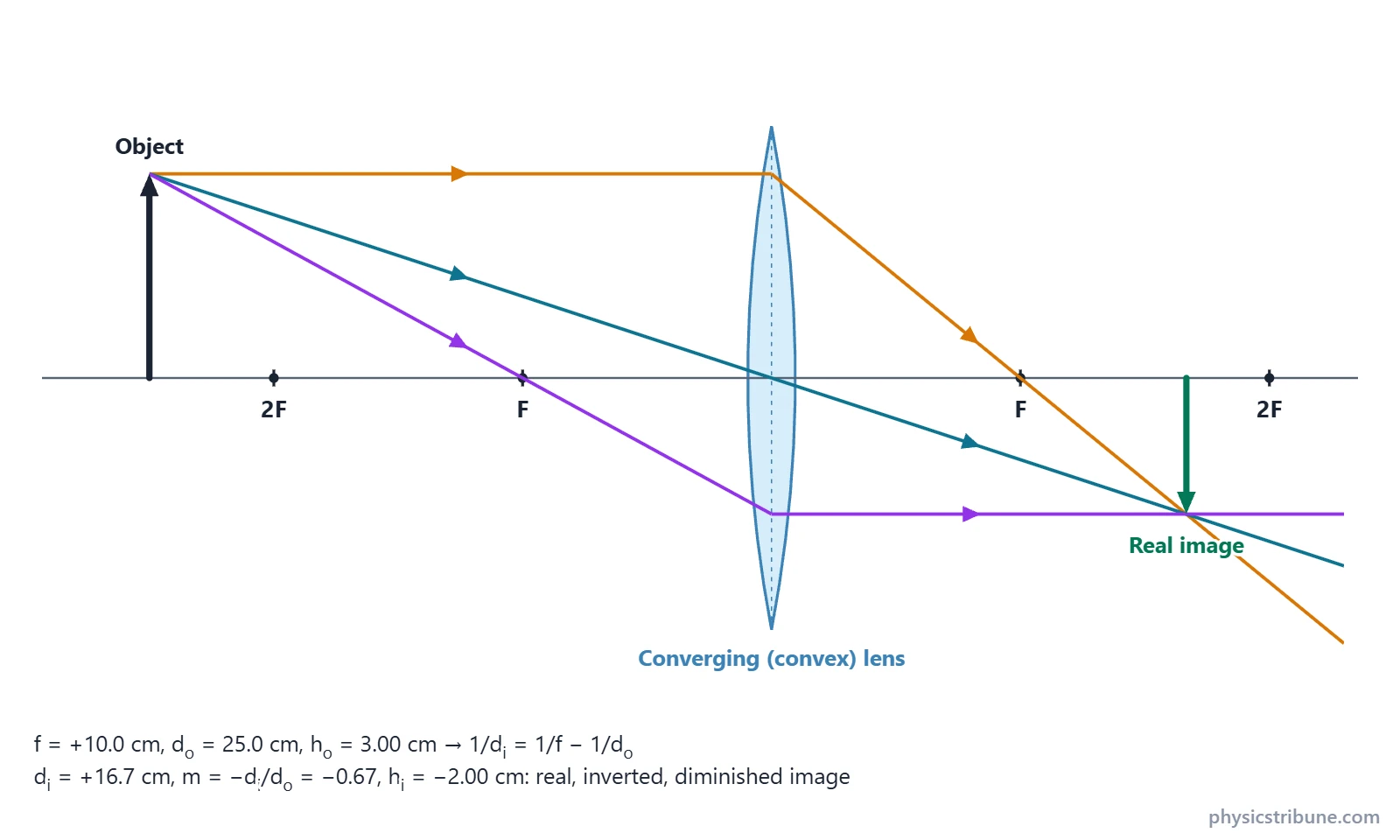
A real image needs light that converges. A convex lens does this by bending rays toward the axis, and a concave mirror does it by reflecting them inward. When the object sits farther away than the focal length, rays from each point cross again on the far side of the lens, or in front of the mirror.
Because the rays cross over on their way to the image, the top of the object ends up at the bottom of the image. That is why real images made by a single lens or mirror are inverted. A camera sensor, the retina in your eye and a cinema screen all receive inverted real images.
A real image exists in space whether or not anything is there to catch it. Place a card at the right spot and it appears sharp; move the card away and the light keeps going and spreads out again.
How Is a Virtual Image Formed?
A virtual image forms whenever the light leaving a device is diverging. A plane mirror, a convex mirror and a concave lens always spread light apart, so for a real object they only ever make virtual images.
A converging lens or concave mirror can make a virtual image too, if the object sits closer than the focal length. The device then bends the rays, but not enough to bring them together. They still diverge, only less steeply, so they appear to come from a larger image farther away. A magnifying glass uses exactly this trick.
The rays leading to a virtual image never cross, so the image keeps the same orientation as the object. A single lens or mirror therefore gives an upright virtual image.
Example 2 How big is the virtual image in a magnifying glass?
A magnifying glass has a focal length of 8.0 cm (0.080 m). It is held 5.0 cm (0.050 m) above a coin. Find the magnification m = -d_i/d_o, using d_i from the thin lens equation.
- Given:
- f:
- object distance:
- f:
- Formula:
- Substitute:
- Answer:
A positive magnification greater than 1 means the image is virtual, upright and enlarged. No screen could catch it, but your eye sees it clearly through the lens.
How Can You Tell if an Image Is Real or Virtual?
Four quick checks work almost every time:
- The screen test: a real image can be focused on paper, a wall or a sensor; a virtual image cannot.
- Orientation: with one lens or mirror, an upside-down image is real and an upright one is virtual.
- Location: for a lens, a real image forms on the opposite side from the object; for a mirror, a real image forms in front of the mirror, on the object's side.
- The sign in the equation: a positive image distance is real and a negative one is virtual.
Orientation needs care in systems with more than one element. A telescope or a periscope can flip and flip back, so its final image may be upright even though a real image formed somewhere inside.
| Device and object position | Real or virtual | Orientation | Size | Where it forms |
|---|---|---|---|---|
| Plane mirror, any distance | Virtual | Upright | Same size | Behind the mirror |
| Convex mirror, any distance | Virtual | Upright | Smaller | Behind the mirror |
| Concave mirror, beyond the focal point | Real | Inverted | Depends on distance | In front of the mirror |
| Concave mirror, inside the focal point | Virtual | Upright | Larger | Behind the mirror |
| Convex lens, beyond the focal point | Real | Inverted | Depends on distance | Opposite side from the object |
| Convex lens, inside the focal point | Virtual | Upright | Larger | Same side as the object |
| Concave lens, any distance | Virtual | Upright | Smaller | Same side as the object |
| Lens or concave mirror, object at the focal point | No image | Not defined | Not defined | Rays leave parallel |
| Source: Follows from 1/f = 1/d_o + 1/d_i and m = −d_i/d_o with the real-is-positive sign convention · Retrieved October 2026 | ||||
How Does the Lens Equation Show Real or Virtual Images?
The thin lens equation and the mirror equation share one form,
The magnification,
Try the numbers yourself with the thin lens equation calculator or the mirror equation calculator. Both draw a ray diagram that shows solid rays for real images and dashed extensions for virtual ones.
The thin lens equation, which has the same form as the mirror equation, tells you where an image forms; the sign of the answer tells you whether it is real or virtual.
| Symbol | Quantity | SI unit |
|---|---|---|
| focal length | meter (m) | |
| object distance | meter (m) | |
| image distance | meter (m) |
Rearranged to find another variable:
Valid for: sign convention: f > 0 converging, f < 0 diverging; d_i > 0 real image (opposite side from object), d_i < 0 virtual image.
Example 1 A slide projector throwing a picture on a wall
A slide projector uses a converging lens with a focal length of 10 cm (0.10 m). The slide sits 10.5 cm (0.105 m) from the lens. How far from the lens must the wall be for a sharp picture?
- Given:
- focal length:
- object distance:
- focal length:
- Formula:
- Substitute:
- Answer:
A positive image distance means a real image that the wall can catch. Because the slide sits just outside the focal length, the image forms far away and much larger, which is why slides are loaded upside down.
Which Images Do Convex and Concave Lenses Form?
A converging lens is the versatile one. With the object beyond the focal length, it makes a real, inverted image; inside the focal length, a virtual, upright, enlarged one. The switch happens exactly at the focal point, where no image forms at all because the rays leave parallel.
A diverging lens is predictable. For any real object it makes a virtual, upright image that is smaller than the object and lies between the lens and its focal point. That is the type of lens in glasses for nearsighted people, and our concave vs convex lens page compares the two in detail.
To sketch these cases quickly, follow the three principal rays described on our ray diagrams page.
Which Images Do Plane, Concave and Convex Mirrors Form?
A flat mirror always makes a virtual, upright, same-size image that sits as far behind the glass as the object is in front. A convex mirror always makes a virtual, upright, smaller image, which is why it gives a wide view in store aisles and on car doors.
A concave mirror behaves like a converging lens. Beyond its focal point it forms a real, inverted image in front of the mirror; inside its focal point it forms a virtual, upright, enlarged image behind it. A makeup mirror held close to your face shows the second case.
The comparison between the two curved types is laid out on concave vs convex mirror.
Example 3 Where is the image in a car's side mirror?
A convex side mirror on a car has a focal length of 50 cm, so f = -0.50 m. A cyclist riding behind the car is 2.0 m from the mirror's surface. Where does the cyclist's image form?
- Given:
- focal length (= R/2):
- object distance:
- focal length (= R/2):
- Formula:
- Substitute:
- Answer:
The negative answer places a virtual, upright, smaller image just behind the glass, which is why such mirrors carry a warning that objects are closer than they appear.
What Are Everyday Examples of Real and Virtual Images?
Real images are everywhere light has to land on something. A phone camera lens throws a tiny real image onto its sensor. A classroom projector throws a large one onto a screen. Your own eye forms a real image on the retina, upside down, and the brain turns it the right way up.
Virtual images are what you see when you look into an optical device. Your reflection in a window at night, the enlarged print under a magnifier, the shrunken scene in a convex mirror and the image through a peephole are all virtual. So is the picture you see through binoculars, whose eyepieces act as magnifiers on an internal real image.
Many instruments use both. A microscope first makes an enlarged real image inside the tube, then the eyepiece turns it into a still larger virtual image for your eye.

Who First Explained How the Eye Forms a Real Image?
People had seen real images for centuries in the camera obscura, a dark room where light through a small hole paints an upside-down scene on the far wall. Explaining the eye took longer.
In the early 1600s Johannes Kepler argued that the lens of the eye focuses light into an inverted real image on the retina, much like a camera obscura with a lens. That idea became the starting point for the modern understanding of vision and of optical instruments. See how it works in detail on our human eye page.
How Can You Practice Real and Virtual Image Problems?
Start by classifying images in the table below without looking at the last column, then check yourself. Our reflection and refraction worksheets include printable lens and mirror problems with answer keys. For a refresher on why lenses bend light at all, read refraction and lenses.
Common Misconceptions
Myth: A virtual image is imaginary, so it is not really there in any sense.
Physics: No light reaches the location of a virtual image, but the image is perfectly real to your eye and to a camera pointed into the device. A camera can photograph your reflection in a mirror because the reflected rays enter its lens.
Myth: Real images can only be seen when they land on a screen.
Physics: A real image exists in the air whether or not a screen is there. If you place your eye beyond it, looking back toward the lens, you can see it floating in space, which is how some display tricks and telescopes work.
Myth: Mirrors make virtual images and lenses make real images.
Physics: Both can make either kind. A concave mirror can project a real image, and a convex lens used as a magnifier makes a virtual one. The type depends on the device and on where the object sits relative to the focal point.
Myth: If an image is upright, it must be virtual.
Physics: That rule only holds for a single lens or mirror. Systems with several elements, such as telescopes for land viewing, can produce an upright final image that is real, for example on a camera sensor behind extra lenses.
Key Facts
- A real image forms where light rays actually converge and can be projected onto a screen.
- A virtual image forms where diverging rays only appear to come from and cannot be projected.
- With a single lens or mirror, real images are inverted and virtual images are upright.
- Plane mirrors, convex mirrors and concave lenses only form virtual images of real objects.
- Convex lenses and concave mirrors form real images beyond the focal point and virtual images inside it.
- In the lens and mirror equations, a positive image distance means real and a negative one means virtual.
- Your eye, a camera and a projector use real images; a magnifier and a bathroom mirror show virtual ones.
Quick Quiz: How Well Do You Know Real and Virtual Images?
6 questions. Tap an answer to check it.
Which test best identifies a real image?
Only a real image, where light actually converges, can be caught on a screen.
What kind of image does a convex security mirror form?
A convex mirror spreads light, so it always forms a virtual, upright, smaller image.
A lens equation gives d_i = -0.25 m. What does this mean?
A negative image distance marks a virtual image in the real-is-positive convention.
Where must an object be placed for a convex lens to make a virtual image?
Inside the focal length the rays still diverge after the lens, so the image is virtual.
Which device forms a real image on purpose?
A projector focuses converging light onto a screen, which requires a real image.
For a single lens, a magnification of -2 tells you the image is:
A negative magnification means inverted, which goes with a real image, and its size of 2 means twice as tall.
Frequently Asked Questions
What is the main difference between a real and a virtual image?
A real image forms where light rays actually meet, so it can be projected onto a screen or sensor. A virtual image forms where the rays only appear to come from when traced backward, so it can be seen by looking into the lens or mirror but cannot be caught on a screen.
Is the image in a plane mirror real or virtual?
It is virtual. The light reflects off the front of the mirror and never travels behind it, yet your eyes trace the reflected rays back to a point behind the glass. The image is upright, the same size as you and exactly as far behind the mirror as you stand in front of it.
Can a virtual image be photographed?
Yes. A camera works like an eye: it collects the diverging rays coming from the mirror or lens and its own lens focuses them into a real image on the sensor. That is why you can take a photo of your reflection or of the enlarged view through a magnifying glass.
Why are real images upside down?
To form a real image, rays from the top of the object and rays from the bottom must cross over as they converge. After crossing, the light from the top lands at the bottom of the image and the reverse. So a single lens or mirror always flips a real image, both up and down and left and right.
Does a convex lens form a real or virtual image?
It can form either. When the object is farther from the lens than the focal length, a convex lens makes a real, inverted image on the opposite side. When the object is closer than the focal length, it makes a virtual, upright, enlarged image on the same side, which is how a magnifying glass works.
Is the image formed on the retina real or virtual?
It is real. The cornea and lens of the eye bend light so that rays from each point of a scene meet on the retina, forming a small inverted image. The retina acts as a screen, and the brain interprets the signals so that the world looks the right way up.
What sign does a virtual image have in the lens equation?
In the real-is-positive convention used in most high school and introductory courses, a virtual image has a negative image distance. Its magnification comes out positive, meaning upright. A real image has a positive image distance and a negative magnification, meaning inverted.
Can a concave lens ever make a real image?
Not of a real object. A concave lens always spreads light apart, so the rays leaving it never meet, and the image is always virtual, upright and smaller. It can only help produce a real image when combined with other lenses, or when it receives light that is already converging from an earlier lens.
Keep Exploring




Sources
Constants come from NIST CODATA 2022 (public domain) and unit definitions from the BIPM SI Brochure (CC BY 4.0). Text, diagrams and illustrations are original work by Physics Tribune.