
At a Glance
Quantum entanglement is a state in which two particles are described by one shared wave function, so their measurement results are correlated no matter how far apart they are. For a common pair of entangled photons, the chance that both give the same answer is cos²θ, where θ is the angle between the two detectors' settings. These correlations cannot be used to send messages faster than light.
- What it is
- Two or more particles sharing one quantum state
- Signature
- Correlations stronger than any local classical model allows
- Photon pair rule
- P(same result) = cos²θ for detector angle difference θ
- Faster than light?
- No usable signal; results look random on each side
- Key test
- Bell inequality, first tested in the 1970s
- Recognized by
- Nobel Prize in Physics 2022 (Aspect, Clauser, Zeilinger)
On this page
- What Is Quantum Entanglement?
- What Causes Particles to Become Entangled?
- How Does Entanglement Work, Step by Step?
- How Do Scientists Prove Entanglement Is Real?
- Is Quantum Entanglement Faster Than Light?
- Why Is Entanglement So Fragile?
- Where Is Quantum Entanglement Used?
- Who Discovered Quantum Entanglement?
- Key Facts
- Quiz
- FAQ
What Is Quantum Entanglement?
Normally you can describe two objects separately: this coin shows heads, that coin shows tails. Entangled particles break that habit. The pair has one shared quantum state, and the individual particles have no complete description of their own.
A simple example is a pair of photons whose polarizations always match when measured along the same direction. Before measurement, each photon is in a superposition of horizontal and vertical. Measure one and get horizontal, and the other will also give horizontal along the same axis, whether it is across the table or across a continent.
On its own, each result is a perfect coin toss. The entanglement shows up only when the two lists of results are brought together and compared.
What Causes Particles to Become Entangled?
Entanglement forms whenever particles interact in a way that conserves some quantity jointly but leaves each particle's own share undecided. If a particle with zero total spin breaks into two, conservation guarantees that their spins point opposite ways along any axis you choose, but nothing fixes which particle has which.
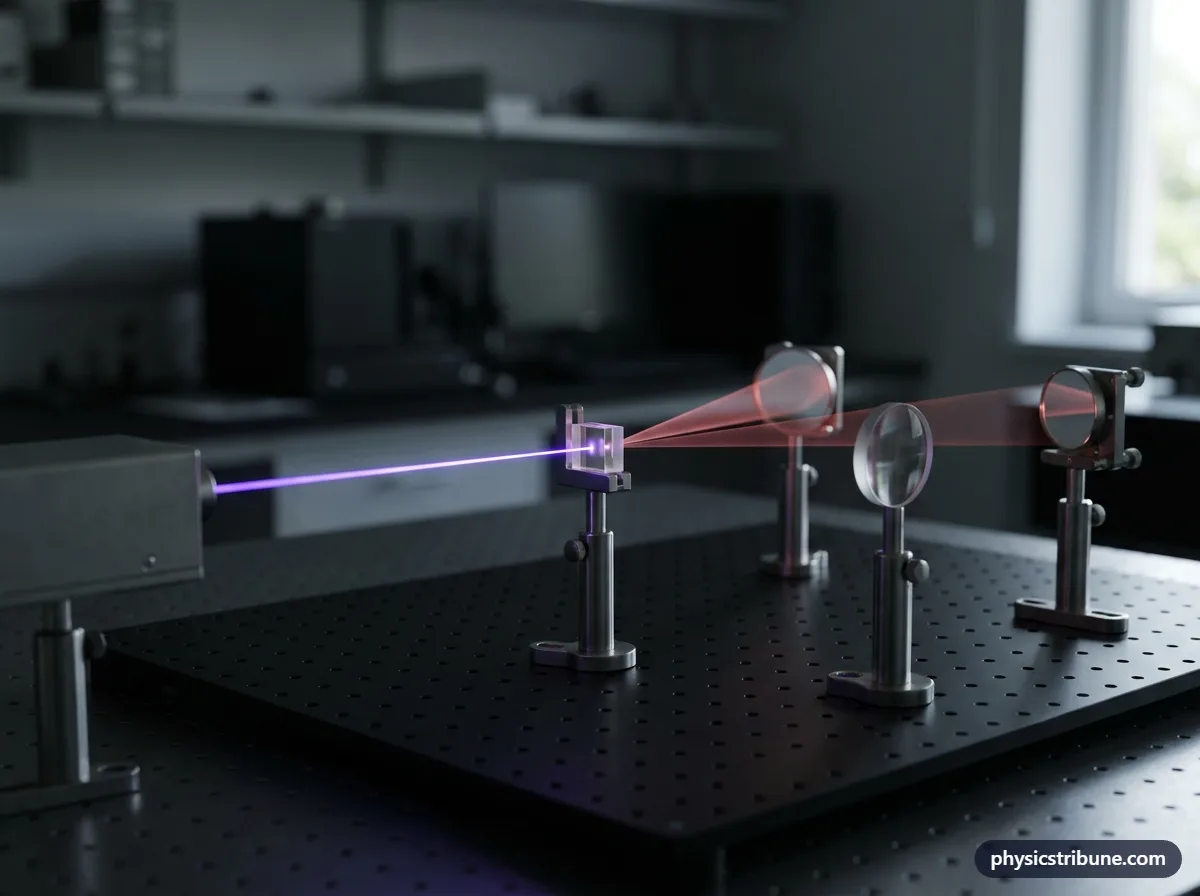
In laboratories, the workhorse is a special crystal pumped by a laser. Now and then one laser photon splits into two lower-energy photons whose polarizations are entangled. Trapped ions, superconducting circuits and atoms can also be entangled by carefully timed pulses that make them interact.
How Does Entanglement Work, Step by Step?
- Create a pair. A source emits two photons in the shared state
- Separate them. The photons fly to two distant labs, often called Alice and Bob.
- Choose settings. Each lab picks an angle for its polarizer at the last moment, independently of the other.
- Measure. Each photon either passes or is blocked. Locally the outcome is random, 50% each way.
- Compare. Afterward the labs swap notes by ordinary means. They find matching results with probability
That cos² rule is the fingerprint. At equal angles the results always agree, at 90° they always disagree, and between those the agreement follows a smooth curve that no model of pre-set hidden answers can copy at every angle.
How Do Scientists Prove Entanglement Is Real?
In 1964 John Bell showed that the question could be settled by experiment. If each particle secretly carried its answers from the start and nothing could travel faster than light between the labs, the correlations would have to obey a limit now called a Bell inequality. Quantum mechanics predicts results that break it.
The table compares the quantum prediction with a simple pre-set-answer model in which agreement falls in a straight line from 0° to 90°. The two match at 0°, 45° and 90°, but quantum physics predicts stronger agreement at small angles and weaker at large ones. In the widely used CHSH version of Bell's test, any local hidden-variable theory gives a score of at most 2, while entangled particles can reach 2√2, about 2.83 (computed).
John Clauser ran an early test in 1972, Alain Aspect closed important gaps in the early 1980s with settings switched during the photons' flight, and Anton Zeilinger's group carried the work into long-distance experiments. In 2015 several teams closed the main remaining loopholes at once, and every result agreed with quantum mechanics.
| Angle difference θ | Quantum prediction cos²θ | Simple pre-set-answer model (1 − θ/90°) |
|---|---|---|
| 0° | 1.000 | 1.000 |
| 22.5° | 0.854 | 0.750 |
| 30° | 0.750 | 0.667 |
| 45° | 0.500 | 0.500 |
| 60° | 0.250 | 0.333 |
| 67.5° | 0.146 | 0.250 |
| 90° | 0.000 | 0.000 |
| Source: Computed with P = cos²θ for the photon state (|HH⟩ + |VV⟩)/√2 and a straight-line local model for comparison · Retrieved October 2026 | ||
Is Quantum Entanglement Faster Than Light?
The correlation appears instantly in the sense that it does not depend on distance, but it cannot carry a message. Whatever Alice does to her photon, Bob's own results remain a random 50/50 sequence. Only when they compare records, using a phone, radio or fiber at or below the speed of light, does the pattern appear.
This is called the no-signaling property, and it keeps entanglement consistent with special relativity. So the answer to whether anything can travel faster than light stays the same: no information or matter can. What entanglement shows is that nature is not local in the classical sense, not that signals can outrun light.
Why Is Entanglement So Fragile?
Entangled particles must stay isolated. Every stray collision with an air molecule, photon of heat or vibration in a crystal can entangle them with the environment instead, spreading their special link across countless particles where it can no longer be seen. This process is called decoherence.
The graph shows how a shared quantum state might fade in a superconducting quantum computer with a typical coherence time of about 100 microseconds. After one coherence time roughly 37% of the original quality is left, and after four, under 2%. Engineers cool such chips to near absolute zero and shield them heavily to stretch that window.

Where Is Quantum Entanglement Used?
- Quantum computing: entangled qubits let an algorithm work with patterns spread across many qubits at once, a key ingredient in quantum speedups.
- Quantum key distribution: two parties sharing entangled photons can build a secret key, and any eavesdropper disturbs the correlations in a detectable way.
- Quantum teleportation: an unknown quantum state can be moved from one particle to a distant one using shared entanglement plus an ordinary message. The original state is destroyed, so nothing is copied.
- Satellite links: in 2017 a Chinese satellite distributed entangled photons to ground stations about 1,200 km apart, showing that the link survives long distances.
- Precision sensors: entangled atoms in some atomic clocks and interferometers can beat the noise limit of independent particles.
Who Discovered Quantum Entanglement?
The idea entered physics as a criticism. In 1935 Albert Einstein, Boris Podolsky and Nathan Rosen argued that perfect correlations between distant particles meant quantum mechanics must be incomplete, an argument now called the EPR paradox. Einstein later described the effect as "spooky action at a distance."
The same year Erwin Schrödinger gave it its name, calling entanglement the defining feature of quantum theory. Bell's 1964 theorem turned the debate into a measurable question, and the experiments that followed earned Aspect, Clauser and Zeilinger the 2022 Nobel Prize in Physics. How to interpret the result is still discussed in the interpretations of quantum mechanics.
Key Facts
- Entangled particles share one quantum state and lack separate definite values before measurement.
- For a common photon pair, the chance of matching results is cos²θ for a detector angle difference θ.
- Each side's results alone look completely random.
- Entanglement cannot send signals faster than light.
- Bell tests show correlations up to 2√2 ≈ 2.83 where local hidden-variable models stop at 2.
- Decoherence from the environment destroys entanglement quickly, so systems must be isolated.
- Aspect, Clauser and Zeilinger won the 2022 Nobel Prize in Physics for entanglement experiments.
Quick Quiz: How Well Do You Know Quantum Entanglement?
6 questions. Tap an answer to check it.
What is special about two entangled particles?
Entangled particles are described by a single joint state, not two separate ones.
For the photon pair on this page, what is the chance of matching results when the detectors differ by 60°?
cos²60° = 0.25, so the results agree one time in four.
Can entanglement be used to send a message faster than light?
The correlation appears only after comparing results through an ordinary channel.
What is the highest CHSH score a local hidden-variable theory can reach?
Local models stop at 2, while entangled particles can reach 2√2.
What usually destroys entanglement?
Stray interactions spread the entanglement into the surroundings, where it is lost.
Who coined the word entanglement?
Schrödinger named it in 1935, the same year as the EPR paper.
Frequently Asked Questions
What is quantum entanglement in simple terms?
It is a special connection between particles that makes their measurement results match up in a coordinated way, even when the particles are far apart. Neither particle has a fixed answer ahead of time, yet when both are measured the same way, their answers agree. The link exists only in the correlations, which appear when the results are compared.
Can quantum entanglement be used to communicate faster than light?
No. Each person measuring one particle sees a random string of results, and nothing they do can change the statistics the other person sees. The correlation becomes visible only after comparing results through an ordinary channel, which is limited by the speed of light. This no-signaling rule keeps entanglement consistent with relativity.
What did Einstein mean by spooky action at a distance?
Einstein used the phrase to express his discomfort with the idea that measuring one particle could seem to affect a distant one instantly. He believed particles must carry hidden instructions that quantum theory ignored. Bell's theorem and the experiments that followed showed that such local hidden instructions cannot reproduce what entangled particles actually do.
How far apart can entangled particles be?
There is no known distance limit in principle. Experiments have kept photons entangled across more than a thousand kilometers using a satellite, and across long optical fibers on the ground. In practice the limit is set by losses and noise along the way, which is why researchers are developing quantum repeaters for longer links.
How do you entangle two particles?
They must interact in a way that ties their properties together. Common methods include splitting one photon into two inside a special crystal, letting a particle with zero spin decay into two, or using precisely timed laser or microwave pulses on trapped ions or superconducting qubits. The hard part is keeping the pair isolated afterward.
What is a Bell test?
A Bell test measures entangled pairs with randomly chosen detector settings and checks whether the correlations exceed a limit that any local hidden-variable theory must respect. The famous CHSH version has a classical maximum of 2. Real experiments routinely reach values well above 2, often around 2.7, approaching the quantum maximum of 2√2.
Is quantum entanglement used in real technology today?
Yes, though mostly in research and early commercial systems. Quantum computers rely on entangled qubits, quantum key distribution uses entangled photons for secure keys, and some precision measurement experiments use entangled atoms to reduce noise. Everyday devices like phones do not use entanglement directly, but the field is growing quickly.
Does measuring one entangled particle change the other one?
Quantum mechanics says the shared state updates as a whole when one particle is measured, so predictions for the other particle change. However, no experiment at the distant particle alone can detect that anything happened. Whether this counts as a physical change or only an update of information depends on the interpretation of quantum mechanics you adopt.
Keep Exploring
 modern physicsQuantum Superposition
 modern physicsQuantum Computing Basics
 modern physicsInterpretations of Quantum Mechanics (Copenhagen, Many-Worlds)
 modern physicsElectron Spin
 lightPolarization of Light
 experimentsSchrödinger's cat
 physicistsAlbert Einstein
 compareClassical vs Quantum Physics
 questionsCan Anything Travel Faster Than Light?
Sources
Constants come from NIST CODATA 2022 (public domain) and unit definitions from the BIPM SI Brochure (CC BY 4.0). Text, diagrams and illustrations are original work by Physics Tribune.