
At a Glance
The Pauli exclusion principle says two identical fermions cannot have the same set of quantum numbers (n, l, m_l, m_s). Because the spin number m_s has only two values, each orbital holds at most two electrons, so a shell with principal number n holds at most 2n^2 electrons: 2, 8, 18, 32.
- Stated by
- Wolfgang Pauli, 1925
- Statement
- No two identical fermions share one quantum state
- In atoms
- No two electrons share all of n, l, ml, ms
- Shell capacity
- 2n² electrons (2, 8, 18, 32, …)
- Applies to
- Fermions (spin 1/2, 3/2, …): electrons, protons, neutrons, quarks
- Recognition
- Nobel Prize in Physics 1945
On this page
- What Does the Pauli Exclusion Principle Say?
- The Pauli Exclusion Principle Explained Simply
- How Do Electrons Fill Energy Levels Under the Pauli Principle?
- How Does the Pauli Principle Build the Periodic Table?
- Why Does the Pauli Exclusion Principle Work?
- Who Discovered the Pauli Exclusion Principle?
- Where Do We See the Pauli Exclusion Principle?
- What Are the Limits of the Pauli Exclusion Principle?
- Practice Pauli Exclusion Principle Problems
- Common Misconceptions
- Key Facts
- Quiz
- FAQ
What Does the Pauli Exclusion Principle Say?
The Pauli exclusion principle says that two identical fermions can never be in exactly the same quantum state. Fermions are particles with half-whole spin, such as electrons, protons and neutrons. A quantum state is the complete description of a particle, so the rule means every electron in a system must differ from every other one in at least one detail.
For an electron in an atom, the full description is a set of four quantum numbers:
The Pauli Exclusion Principle Explained Simply
Think of an atom as a theater where every seat is a quantum state. Each seat is a double seat with a left and a right place, standing for spin up and spin down. Electrons arrive one by one and always take the cheapest open place, but no place may ever hold two electrons.
Once the front row is full, the next electron has no choice but to sit farther back, even though it would prefer the front. That is why electrons stack up in shells instead of all piling into the lowest level. It is also why you cannot squeeze matter much: pushing electrons closer would force some of them into higher, more expensive seats.
How Do Electrons Fill Energy Levels Under the Pauli Principle?
A simple model shows the rule in numbers. An electron trapped in a one-dimensional box of length
So the first two electrons go into
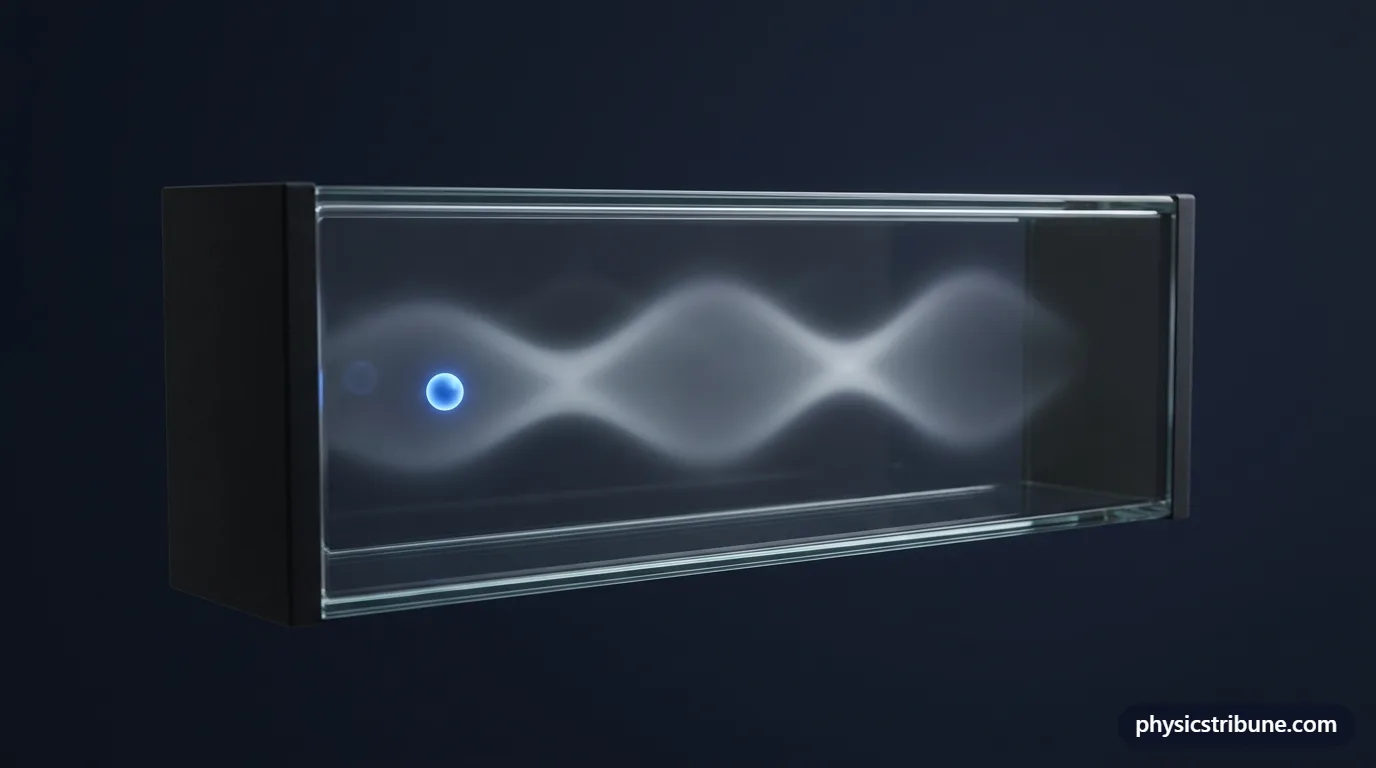
The simplest place to watch the principle at work is an electron trapped in a box, whose allowed energies are given below. Each level can hold only two electrons.
| Symbol | Quantity | SI unit |
|---|---|---|
| energy of level n | joule (J) | |
| quantum number (1, 2, 3, ...) | dimensionless (1) | |
| Planck constant (6.626 × 10⁻³⁴ J·s (exact: 6.62607015 × 10⁻³⁴)) | joule second (J·s) | |
| mass of the particle | kilogram (kg) | |
| width of the box | meter (m) |
Rearranged to find another variable:
Valid for: infinite square well (1D).
Example 1 The lowest level in a one-nanometer box
An electron (m = 9.1093837139 × 10⁻³¹ kg) is confined to a one-dimensional box 1.0 nm long. What is the energy of the lowest level, n = 1, in electronvolts?
- Given:
- quantum number (1, 2, 3, ...):
- Planck constant:
- mass of the particle:
- width of the box:
- quantum number (1, 2, 3, ...):
- Formula:
- Substitute:
- Answer:
Without the exclusion principle, every electron added to this box could crowd into this one level.
Example 2 Six electrons in a short molecule-sized box
Six electrons share a one-dimensional box 0.80 nm long. Each level can hold two electrons with opposite spins, so the levels fill from the bottom up and the top electrons sit in level n = 3. What is the energy of that highest occupied level, in electronvolts?
- Given:
- quantum number (1, 2, 3, ...):
- Planck constant:
- mass of the particle:
- width of the box:
- quantum number (1, 2, 3, ...):
- Formula:
- Substitute:
- Answer:
Chemists use this kind of estimate for chain-shaped molecules whose shared electrons move along the whole chain; the gap to the empty level above sets the color of light they absorb.
| Level n | Energy (eV) | Electrons allowed | Running total of electrons |
|---|---|---|---|
| 1 | 0.376 | 2 | 2 |
| 2 | 1.504 | 2 | 4 |
| 3 | 3.384 | 2 | 6 |
| 4 | 6.016 | 2 | 8 |
| 5 | 9.401 | 2 | 10 |
| Source: Computed with E_n = n²h²/(8mL²), L = 1.0 nm, h and m_e from NIST CODATA 2022 · Retrieved October 2026 | |||
How Does the Pauli Principle Build the Periodic Table?
In real atoms the same filling rule produces shells. A shell with principal number
Those numbers are the skeleton of the periodic table. Helium fills the first shell and neon completes the second, which is why both are unreactive noble gases. Sodium has one electron beyond neon's closed core, so it gives that electron away easily, while fluorine is one short and grabs electrons eagerly. Without the exclusion principle, every electron would drop into the lowest orbital, all atoms would behave much alike and chemistry as we know it would not exist.
The order in which subshells fill also depends on the repulsion between electrons, and spins spread out across equal-energy orbitals before pairing up, a pattern known as Hund's rule. The exclusion principle sets the hard limits; those finer rules decide the details.
| Shell n | Subshells (l values) | Orbitals (n²) | Max electrons (2n²) | First element with this shell full |
|---|---|---|---|---|
| 1 | s | 1 | 2 | Helium (Z = 2) |
| 2 | s, p | 4 | 8 | Neon (Z = 10) |
| 3 | s, p, d | 9 | 18 | Copper (Z = 29) |
| 4 | s, p, d, f | 16 | 32 | Ytterbium (Z = 70) |
| Source: Computed from the quantum-number rules (l = 0 to n − 1, m_l = −l to +l, m_s = ±1/2); elements from standard ground-state electron configurations · Retrieved October 2026 | ||||
Why Does the Pauli Exclusion Principle Work?
The deeper reason lies in how quantum mechanics treats identical particles. Two electrons are truly indistinguishable, so swapping them cannot change anything you can measure. For fermions, the mathematics requires that swapping two of them flips the sign of the combined wave function. If both were in the same state, swapping them would leave the wave function unchanged and flip its sign at once, which is only possible if it is zero everywhere. A state that is zero everywhere cannot happen.
Bosons, the particles with whole-number spin, follow the opposite rule and do not change sign. They happily crowd into a single state, which is how a laser beam fills with identical photons and how a Bose-Einstein condensate forms. In 1940 Pauli proved the spin-statistics theorem, which shows that half-whole spin always comes with exclusion. See bosons and fermions for the full contrast.
Who Discovered the Pauli Exclusion Principle?
Wolfgang Pauli, an Austrian physicist then in his mid-twenties, stated the principle in 1925 while trying to explain the patterns of atomic spectra and the lengths of the periods in the periodic table. To make the counting work, he argued that each electron needs a fourth quantum number that can take only two values. Within months, Uhlenbeck and Goudsmit identified that number with electron spin.
Pauli's rule fit the shell structure perfectly and quickly became a pillar of quantum theory. Enrico Fermi and Paul Dirac built on it in 1926 to describe how large crowds of electrons behave, which is why such particles are called fermions. Pauli received the 1945 Nobel Prize in Physics for the exclusion principle.
Where Do We See the Pauli Exclusion Principle?
- Solid matter. When you push on a table, the electron clouds of its atoms and your hand resist overlapping. Electric repulsion and the exclusion principle together give that contact force, which is why objects do not pass through each other.
- Metals. The free electrons in copper fill levels up to an energy of about 7 eV (computed with a free-electron model). Even at absolute zero they keep moving fast, which shapes how metals conduct electricity and heat.
- Chemical bonds. A single covalent bond is a pair of electrons, and the pair works because they must have opposite spins to share the same region between atoms.
- White dwarf stars. When a star like the Sun dies, gravity squeezes its core to about the size of Earth. Electron degeneracy pressure, a direct result of exclusion, stops the collapse.
- Neutron stars. In heavier collapsed cores, neutrons, which are also fermions, resist further squeezing, along with the strong nuclear force.
Example 3 How much energy the exclusion principle adds
Four electrons sit in the same 1.0 nm box as before. By the exclusion principle, two go into n = 1 and two into n = 2. What is their total energy, in electronvolts?
- Given:
- Planck constant:
- mass of the particle:
- width of the box:
- Planck constant:
- Formula:
- Substitute:
- Answer:
If all four could share level 1, the total would be only 4 × 0.376 = 1.50 eV. The extra energy is the price of exclusion, and in metals and stars it shows up as a real outward pressure.

What Are the Limits of the Pauli Exclusion Principle?
The principle applies only to identical fermions. An electron and a proton can share a state, because they are different particles. Bosons such as photons ignore it completely. Two electrons in two different atoms far apart also do not break the rule, since their positions make their states different.
Exclusion pressure is not unlimited either. A white dwarf heavier than about 1.4 solar masses, the Chandrasekhar limit worked out by Subrahmanyan Chandrasekhar, cannot be held up by its electrons and collapses further. The principle itself never fails, but the pressure it produces can be overwhelmed when gravity pushes electrons to near light speed.


Practice Pauli Exclusion Principle Problems
Practice writing electron configurations and counting shell capacities with our atomic structure worksheets. To turn a gap between filled and empty levels into a wavelength of absorbed light, use the photon energy calculator. The modern physics formulas sheet collects the particle-in-a-box energy and the other equations on this page, and classical vs quantum physics explains why this rule has no classical counterpart.
Common Misconceptions
Myth: The Pauli principle is a force that pushes electrons apart.
Physics: It is not a force but a rule about allowed states. Its effects, such as degeneracy pressure, look like a repulsion because squeezing fermions forces them into higher-energy states.
Myth: No two electrons anywhere in the universe can have the same quantum numbers.
Physics: The rule applies within one system. Electrons in separate atoms have different positions, so their full quantum states already differ.
Myth: All particles obey the exclusion principle.
Physics: Only fermions do. Bosons, like photons and helium-4 atoms, can pile into the same state, which makes lasers and superfluids possible.
Myth: Two electrons in one orbital must have the same spin.
Physics: They must have opposite spins, one +1/2 and one −1/2, since everything else about their state is the same.
Key Facts
- No two identical fermions can occupy the same quantum state at the same time.
- In an atom, no two electrons can share all four quantum numbers n, l, m_l and m_s.
- Each orbital holds at most two electrons, and they must have opposite spins.
- A shell with principal number n holds at most 2n² electrons: 2, 8, 18, 32.
- Wolfgang Pauli stated the principle in 1925 and won the 1945 Nobel Prize for it.
- Bosons such as photons are not restricted and can share a single state in any number.
- Electron degeneracy pressure from the principle holds up white dwarf stars up to about 1.4 solar masses.
Quick Quiz: How Well Do You Know Pauli Exclusion Principle?
6 questions. Tap an answer to check it.
Which particles must obey the Pauli exclusion principle?
The rule applies to identical fermions, which have half-whole spin.
How many electrons can a single orbital hold?
Two electrons with opposite spins exhaust the possible values of m_s.
What is the maximum number of electrons in the n = 3 shell?
A shell holds 2n² electrons, and 2 × 3² = 18.
Two electrons share an orbital. What must be true about them?
Everything else matches, so m_s must differ: one up, one down.
What holds up a white dwarf star against gravity?
Packed electrons cannot share states, which creates an outward pressure even without heat.
In which year did Pauli state the exclusion principle?
Pauli formulated it in 1925; the Nobel Prize followed in 1945.
Frequently Asked Questions
What is the Pauli exclusion principle in simple terms?
It is the rule that two electrons, or any two identical fermions, can never be in exactly the same quantum state. In an atom, that means each orbital can hold at most two electrons, and those two must spin in opposite directions. Because of this, electrons stack into shells instead of all crowding into the lowest level, which gives every element its own chemistry.
Why can only two electrons fit in one orbital?
An orbital fixes three of an electron's four quantum numbers: n, l and m_l. The only thing left to tell two electrons apart is the spin number m_s, which has just two possible values, +1/2 and −1/2. So one electron takes spin up and the other spin down. A third electron would have to copy one of them exactly, which the principle forbids.
What are the four quantum numbers in the Pauli principle?
They are the principal number n, which sets the shell and most of the energy; the angular momentum number l, which sets the orbital shape; the magnetic number m_l, which sets the orbital's orientation; and the spin number m_s, which is +1/2 or −1/2. The Pauli principle says no two electrons in the same atom can have the same values of all four.
Does the Pauli exclusion principle apply to protons and neutrons?
Yes. Protons and neutrons are fermions with spin 1/2, so identical ones cannot share a state. In a nucleus, protons and neutrons fill their own separate sets of levels, which explains why some numbers of nucleons give especially stable nuclei. In neutron stars, the exclusion of neutrons provides part of the pressure that resists gravity.
Why don't photons obey the Pauli exclusion principle?
Photons have spin 1, which makes them bosons rather than fermions. Bosons follow the opposite rule: any number of them can share the same quantum state, and they even tend to gather there. That is exactly what happens in a laser, where enormous numbers of photons share one direction, wavelength and phase. The spin-statistics theorem links whole-number spin to this behavior.
How does the Pauli exclusion principle make matter solid?
Atoms are mostly empty space, yet matter resists being squeezed. When two atoms are pushed together, their electron clouds would have to overlap, and the exclusion principle forces some electrons into higher-energy states to make room. That energy cost, along with electric repulsion, acts as a strong push back, which is why your hand stops at a table instead of sinking into it.
What is electron degeneracy pressure?
It is the pressure that comes from electrons being forbidden to share states. Even at zero temperature, packed electrons must fill higher and higher momentum levels, so they keep moving and push outward. This pressure does not depend on heat. It is what holds up white dwarf stars after nuclear burning stops, as long as their mass stays below about 1.4 solar masses.
Who discovered the Pauli exclusion principle and when?
Austrian physicist Wolfgang Pauli formulated it in 1925 to explain the structure of atomic spectra and the periodic table. He introduced a fourth, two-valued quantum number that was soon recognized as electron spin. In 1940 he proved the spin-statistics theorem behind it, and in 1945 he received the Nobel Prize in Physics for the discovery.
What would happen without the Pauli exclusion principle?
All electrons in an atom would fall into the lowest orbital. Atoms would shrink, the shell structure would disappear and elements would no longer have their distinct chemical behavior, so ordinary molecules could not form. Matter could also be compressed far more easily, and stars would not have white dwarf endings. The world as we know it depends on this one rule.
Keep Exploring




Sources
Constants come from NIST CODATA 2022 (public domain) and unit definitions from the BIPM SI Brochure (CC BY 4.0). Text, diagrams and illustrations are original work by Physics Tribune.