
At a Glance
A manometer measures pressure by how far a liquid is pushed along a tube. In a U-tube manometer the level difference h between the two arms gives the pressure difference P = ρ g h, where ρ is the density of the manometer liquid. An open-end manometer reads gauge pressure, and a closed-end one reads absolute pressure.
- Measures
- Pressure difference (usually gauge pressure of a gas)
- Formula
- ΔP = ρgh (h = difference in liquid levels)
- SI unit of the reading
- pascal (Pa); also inches of water, mmHg
- Common liquids
- Water, colored oil, mercury
- Main types
- U-tube, well (reservoir), inclined, differential, digital
- Typical uses
- Gas lines, HVAC ducts, labs, blood pressure, flow meters
On this page
- What Is a Manometer?
- How Does a U-Tube Manometer Work?
- What Is the Manometer Formula?
- What Is the Difference Between Open and Closed Manometers?
- What Are the Main Types of Manometers?
- How Is a Manometer Used to Measure Flow?
- Where Are Manometers Used?
- Who Invented the Manometer?
- Is a Manometer the Same as a Barometer?
- Common Misconceptions
- Key Facts
- Quiz
- FAQ
What Is a Manometer?
A manometer is a pressure gauge that uses a liquid column instead of springs or electronics. It compares an unknown pressure with a reference pressure and shows the difference as a height. In most cases the reference is the open air, so the reading is a gauge pressure.
The simplest manometer is a transparent tube bent into a U and half filled with liquid. With both ends open to the room, the two surfaces sit at the same level. Connect one end to a gas line, a duct or a tank, and the liquid moves until the levels differ by an amount that matches the extra pressure.
Because the reading comes straight from a height and a density, a liquid manometer needs no calibration curve. That makes it a trusted reference for checking other gauges, and it is still common in labs, heating trades and teaching.
How Does a U-Tube Manometer Work?
A U-tube manometer works by letting two pressures fight over the same liquid until they balance. Here is what happens, step by step:
- Liquid fills the bottom of the U, and both surfaces start at the same height because both arms feel the same air pressure.
- One arm is connected to the gas you want to measure. The other stays open to the atmosphere.
- If the gas pressure is higher than the air pressure, it pushes its surface down, and the liquid rises in the open arm.
- The liquid stops moving when the weight of the extra column in the open arm exactly balances the extra push of the gas.
- You read the vertical distance h between the two surfaces. That height, together with the liquid's density, gives the pressure difference.
The diagram shows that balance for a tube with a 1 cm² cross-section. The gas pushes a little harder than the air, and that extra push is held up by the weight of a 10 cm column of water. Air pressure acts on both sides, so it cancels out of the balance.

What Is the Manometer Formula?
The liquid is at rest, so this is a hydrostatic pressure problem. Two points at the same height in the same connected liquid must be at the same pressure. Comparing the two arms at the level of the lower surface gives
Three things follow from this formula. The tube's width does not matter, only the vertical difference in levels. The reading depends on the liquid, so a manometer scaled for water gives wrong numbers if you fill it with oil. And a denser liquid shows a smaller height for the same pressure.
That last point lets you choose the liquid to suit the job. Water or light oil spreads a small pressure over a readable height, while mercury squeezes a large pressure into a short tube. The table compares the heights for the same 1 kPa difference, and our density page explains where those densities come from.
The liquid in a manometer is at rest, so the extra pressure on one side equals the hydrostatic pressure of the extra column on the other side.
| Symbol | Quantity | SI unit |
|---|---|---|
| pressure due to the fluid column (gauge pressure) | pascal (Pa) | |
| fluid density | kilogram per cubic meter (kg/m³) | |
| acceleration due to gravity (9.80 m/s² (standard 9.80665 m/s²)) | meter per second squared (m/s²) | |
| depth below the surface | meter (m) |
Rearranged to find another variable:
Valid for: incompressible fluid at rest; add atmospheric pressure for absolute pressure.
Example 1 Checking a furnace gas line
A technician connects a water-filled U-tube manometer to the gas supply of a furnace. The water on the open side stands 0.12 m higher than on the gas side. Using a water density of 998 kg/m³ and g = 9.81 m/s², what is the gauge pressure of the gas?
- Given:
- fluid density:
- acceleration due to gravity:
- depth below the surface:
- fluid density:
- Formula:
- Substitute:
- Answer:
This is gauge pressure, the amount the gas pressure exceeds the room's air pressure. A level difference of about 12 cm of water is a few inches of water column, the usual way gas pressure is quoted in homes.
Example 3 Sizing an oil manometer
A lab needs a manometer that shows a gauge pressure of 2,500 Pa clearly. It will be filled with a gauge oil of density 850 kg/m³, and g = 9.81 m/s². What level difference will the oil show at that pressure?
- Given:
- pressure due to the fluid column (gauge pressure):
- fluid density:
- acceleration due to gravity:
- pressure due to the fluid column (gauge pressure):
- Formula:
- Substitute:
- Answer:
A less dense liquid gives a taller, easier-to-read column for the same pressure, which is why light oils are popular for small pressures.
| Manometer liquid | Typical density (kg/m³) | Level difference for 1 kPa (cm) |
|---|---|---|
| Ethanol (colored) | 789 | 12.9 |
| Light gauge oil | 850 | 12.0 |
| Water (20 °C) | 998 | 10.2 |
| Mercury (0 °C) | 13,595 | 0.75 |
| Source: Computed with h = ΔP / (ρg), ΔP = 1,000 Pa, g = 9.80665 m/s²; densities are typical values · Retrieved October 2026 | ||
What Is the Difference Between Open and Closed Manometers?
An open-end manometer has one arm open to the room. It measures the gas pressure relative to the air, which is gauge pressure. If the liquid is higher on the open side, the gas pressure is above atmospheric. If it is higher on the gas side, the gas is below atmospheric, a partial vacuum.
A closed-end manometer has its reference arm sealed, with an almost empty space above the liquid. Nothing pushes on that surface, so the level difference shows the gas pressure measured from a vacuum. That is an absolute pressure, the same kind of reading a barometer gives.
You can always turn one reading into the other. Absolute pressure equals gauge pressure plus the local atmospheric pressure, which is what the second worked example does.
Example 2 Absolute pressure in a sealed flask
A flask of gas is connected to an open-end mercury manometer. The mercury in the open arm stands 0.065 m higher than in the arm joined to the flask. Air pressure in the room is 101,325 Pa, mercury has a density of 13,595 kg/m³ and g = 9.81 m/s². What is the absolute pressure of the gas?
- Given:
- pressure at the surface (often atmospheric, 1.013 × 10⁵ Pa):
- fluid density:
- acceleration due to gravity:
- depth:
- pressure at the surface (often atmospheric, 1.013 × 10⁵ Pa):
- Formula:
- Substitute:
- Answer:
The gas pushes harder than the room air, which is why the mercury is driven up the open arm. If the open arm were lower, you would subtract ρgh instead.
What Are the Main Types of Manometers?
- U-tube manometer. Two equal arms and a liquid at the bottom. Simple, cheap and accurate, the standard for teaching and quick checks.
- Well-type (reservoir) manometer. One arm is replaced by a wide reservoir. Its surface barely moves, so you read a single column, which halves the reading work.
- Inclined manometer. The reading tube is tilted at a shallow angle. A small vertical rise becomes a long movement along the tube, so tiny pressures, such as the draft in a chimney or the push in an air duct, are easier to read.
- Differential manometer. Both arms connect to the system, for example across a filter or a narrow section of pipe. It reads the pressure difference between two points rather than against the room.
- Digital manometer. A handheld meter with an electronic pressure sensor. It keeps the old name because it does the same job, and it usually displays in pascals, inches of water or millibars.
- Sphygmomanometer. The blood pressure cuff. Older models used a mercury column, which is why blood pressure is still given in millimeters of mercury.
How Is a Manometer Used to Measure Flow?
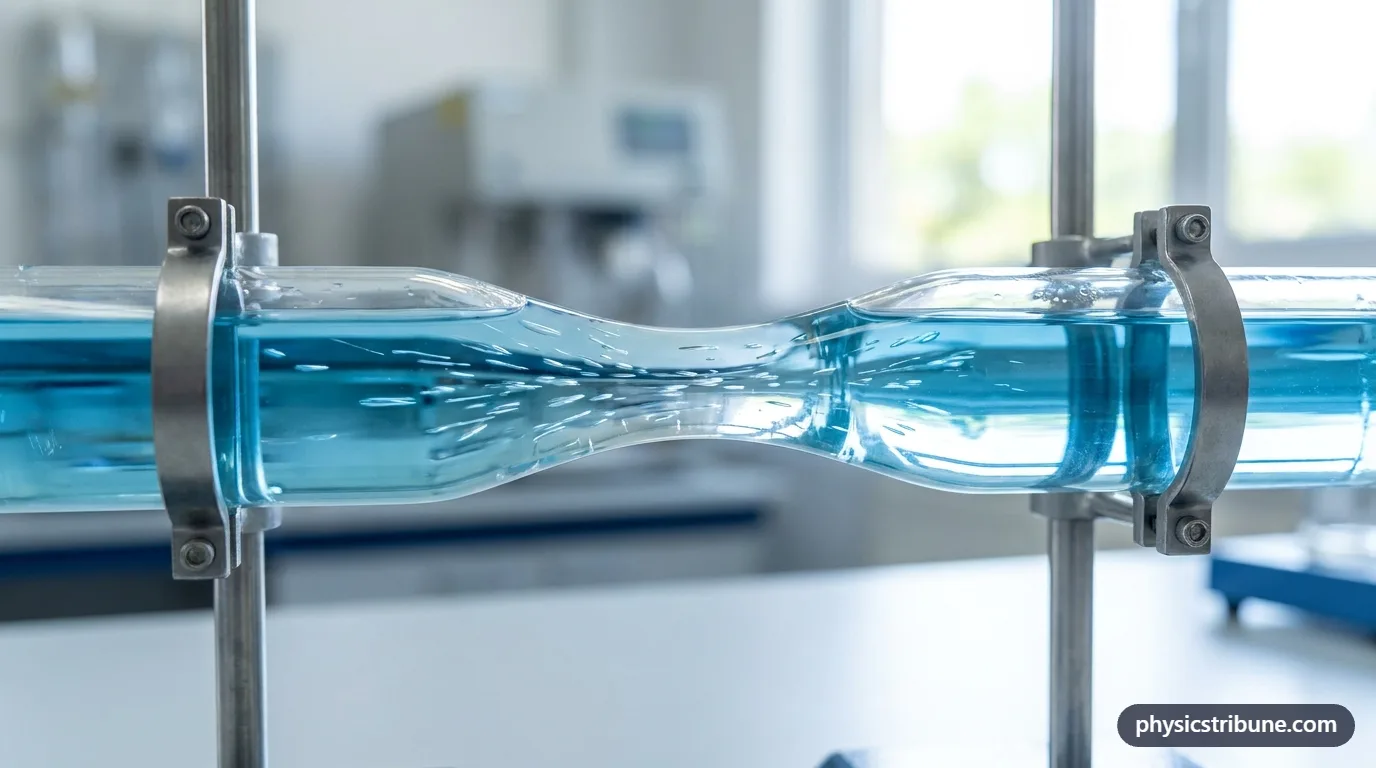
A differential manometer can tell you how fast a fluid is moving, not just how hard it pushes. When water speeds up through a narrow section of pipe, its pressure drops, a result of Bernoulli's principle. A device built around that narrowing is called a Venturi meter, and our page on the Venturi effect covers the physics.
Two vertical tubes, one on the wide section and one on the throat, act as a simple manometer. The liquid stands lower above the throat because the pressure there is lower. Engineers measure that height difference, then use the continuity and Bernoulli equations to work back to the flow speed.
The diagram shows water entering at 1 m/s through a pipe that halves its area. The water doubles its speed in the throat, and the pressure columns differ by about 15 cm. A Pitot tube on an aircraft or in a wind tunnel uses the same idea, comparing the pressure of air brought to rest with the pressure of air flowing past.

Where Are Manometers Used?
Manometers turn up wherever a small pressure difference matters more than a large absolute pressure:
- Gas appliances. Fitters check the supply pressure to stoves, boilers and furnaces, often quoted in inches of water column.
- Heating and ventilation. Inclined or digital manometers measure the pressure across fans, ducts and air filters, so a clogged filter shows up as a rising reading.
- Clean rooms and labs. A room kept slightly above or below the corridor pressure stops dust or fumes from crossing the doorway, and a wall manometer shows that the difference is holding.
- Medicine. Blood pressure is measured as a pressure above atmospheric, so it is a gauge reading, a link explored on our pressures in the body page.
- Flow and weather research. Wind tunnels and pipe test rigs use banks of liquid columns to map pressure along a model or a pipe.
The table converts some of these everyday readings into pascals. For the unit conversions themselves, see our guide to units of pressure.
| Situation | Typical reading | In pascals |
|---|---|---|
| Air pushed through a home ventilation duct | about 0.5 inH₂O | about 125 Pa |
| Natural gas supply to a home appliance | about 7 inH₂O | about 1,740 Pa |
| Normal resting blood pressure, top number | 120 mmHg | about 16,000 Pa |
| Normal resting blood pressure, bottom number | 80 mmHg | about 10,670 Pa |
| 1 mm of water column | 1 mmH₂O | 9.81 Pa |
| 1 mm of mercury | 1 mmHg | 133.3 Pa |
| Source: Computed with 1 inH₂O = 249.09 Pa and 1 mmHg = 133.322 Pa; duct, gas and blood pressure values are typical, not exact · Retrieved October 2026 | ||

Who Invented the Manometer?
Liquid-column pressure gauges grew out of seventeenth-century work on air and vacuum. Evangelista Torricelli showed in the 1640s that a mercury column can balance the weight of the air, and later experimenters bent and sealed such tubes to compare one pressure with another. Robert Boyle used a J-shaped tube of mercury in the 1660s to study how a trapped gas responds to pressure.
The U-tube became the everyday workhorse because it is so easy to build. In the nineteenth century, mechanical gauges such as the Bourdon tube began to replace liquid columns for high pressures, while liquid manometers stayed in use for small pressures and for calibration. Mercury blood pressure gauges appeared in the 1890s and dominated clinics for about a century.
Is a Manometer the Same as a Barometer?
No, although they are close relatives. A barometer measures the pressure of the open air itself, against a vacuum. A manometer usually measures the pressure of something else, a gas line, a tank or a duct, against the air around it.
Put simply, a barometer reads absolute pressure and an open-end manometer reads gauge pressure. A closed-end manometer blurs the line, since it also reads against a vacuum. To practice both kinds of problem, try our pressure calculator and the pressure worksheets, and if force and pressure still feel alike, read force vs pressure.
Common Misconceptions
Myth: A wider manometer tube gives a bigger reading.
Physics: The level difference depends only on the pressure difference and the liquid's density. A wider tube holds more liquid but shows the same height.
Myth: A manometer always shows the full pressure of the gas.
Physics: An open-end manometer shows only how far the gas pressure is above or below the air pressure. To get absolute pressure, add the atmospheric pressure.
Myth: You can swap water for oil without changing the scale.
Physics: The scale is tied to the liquid's density. Oil is less dense than water, so the same pressure lifts it higher and a water scale would read too high.
Key Facts
- A manometer measures pressure from the difference in height of a liquid in two connected arms.
- The pressure difference is ΔP = ρgh, where ρ is the density of the manometer liquid and h is the level difference.
- An open-end manometer reads gauge pressure, while a closed-end manometer reads absolute pressure.
- Only the vertical level difference matters; the tube's width and shape do not change the reading.
- A 1 kPa difference lifts water about 10 cm but mercury only about 7.5 mm.
- Inclined manometers stretch a small vertical rise along a sloping tube so tiny pressures can be read.
- Blood pressure is still quoted in millimeters of mercury because early gauges used a mercury column.
Quick Quiz: How Well Do You Know Manometer?
6 questions. Tap an answer to check it.
What does an open-end U-tube manometer measure?
It compares the gas with the surrounding air, so it reads pressure above or below atmospheric.
Which quantity does NOT affect the level difference in a manometer?
In ΔP = ρgh the tube width does not appear, so it has no effect.
In an open-end manometer, the liquid stands higher on the open side. What does that tell you?
The higher-pressure side pushes its surface down, so the liquid rises on the open side.
For the same pressure difference, which liquid shows the largest height?
Ethanol is the least dense, and h = ΔP/(ρg) grows as density falls.
Why is an inclined manometer used for very small pressures?
Tilting the tube turns a tiny height change into a longer, easier-to-read movement.
A closed-end manometer reads which kind of pressure?
Its sealed arm holds a near vacuum, so the reading is measured from zero pressure.
Frequently Asked Questions
What does a manometer measure?
A manometer measures a pressure difference. Most often it compares the pressure of a gas with the pressure of the surrounding air, which gives gauge pressure. A differential manometer compares two points in a system, such as either side of a filter, and a closed-end manometer compares a gas with a vacuum, which gives absolute pressure. The result is shown as a difference in liquid levels.
How do you read a U-tube manometer?
Measure the vertical distance between the two liquid surfaces, from the bottom of one curved surface to the bottom of the other for water, or the tops for mercury. Then multiply that height by the liquid's density and by g to get the pressure difference in pascals. The side where the liquid is pushed down is the side with the higher pressure.
What is the formula for a manometer?
For a simple U-tube the pressure difference is ΔP = ρgh, with ρ the density of the manometer liquid, g the acceleration due to gravity and h the vertical difference between the two surfaces. For an open-end manometer the absolute gas pressure is P = P0 + ρgh, where P0 is the atmospheric pressure, and you subtract instead of add when the gas side is higher.
Why is mercury used in some manometers?
Mercury is about 13.6 times denser than water, so it shows a much smaller height for the same pressure. That keeps the tube short when the pressure is large, for example near atmospheric pressure or in older blood pressure gauges. Mercury is toxic, though, so water, colored oil and electronic sensors have replaced it for most everyday work.
What is the difference between a manometer and a pressure gauge?
A manometer is one kind of pressure gauge, the kind that uses a liquid column. Other gauges use a curved metal tube that straightens under pressure, a flexible diaphragm, or an electronic sensor. Liquid manometers are best for small pressure differences and for checking other instruments, while mechanical and electronic gauges handle high pressures and rough conditions.
What does inches of water column mean?
It is a pressure unit taken from a water manometer: the pressure that holds up a column of water one inch tall. One inch of water is about 249 Pa, a very small pressure. It is used for gas supply lines, ventilation systems and chimney drafts, where the pressures are only a tiny fraction of atmospheric pressure.
Can a manometer measure a vacuum?
Yes. If the gas pressure is lower than the air pressure, the liquid is pulled up on the gas side and pushed down on the open side. The level difference then shows how far the pressure is below atmospheric. A closed-end manometer can also read low absolute pressures directly, because its reference side is already close to a vacuum.
Is a blood pressure monitor a manometer?
The traditional cuff, called a sphygmomanometer, is a manometer. Older ones used a mercury column and newer ones use a dial or an electronic sensor, but all of them measure how far the pressure in the cuff is above atmospheric pressure. That is why a reading such as 120 over 80 is given in millimeters of mercury, a gauge pressure.
Keep Exploring




Sources
Constants come from NIST CODATA 2022 (public domain) and unit definitions from the BIPM SI Brochure (CC BY 4.0). Text, diagrams and illustrations are original work by Physics Tribune.